How Much Does an Operations Consultant Cost in Canada?
A direct answer up front: it depends on the model. Hourly consultants bill by the hour, large firms cost the most, and outcome-based fractional engagements sit in the middle with far more predictable pricing. Here is how the market actually breaks down.

Founder & CEO · Navigator · Sudbury, Ontario
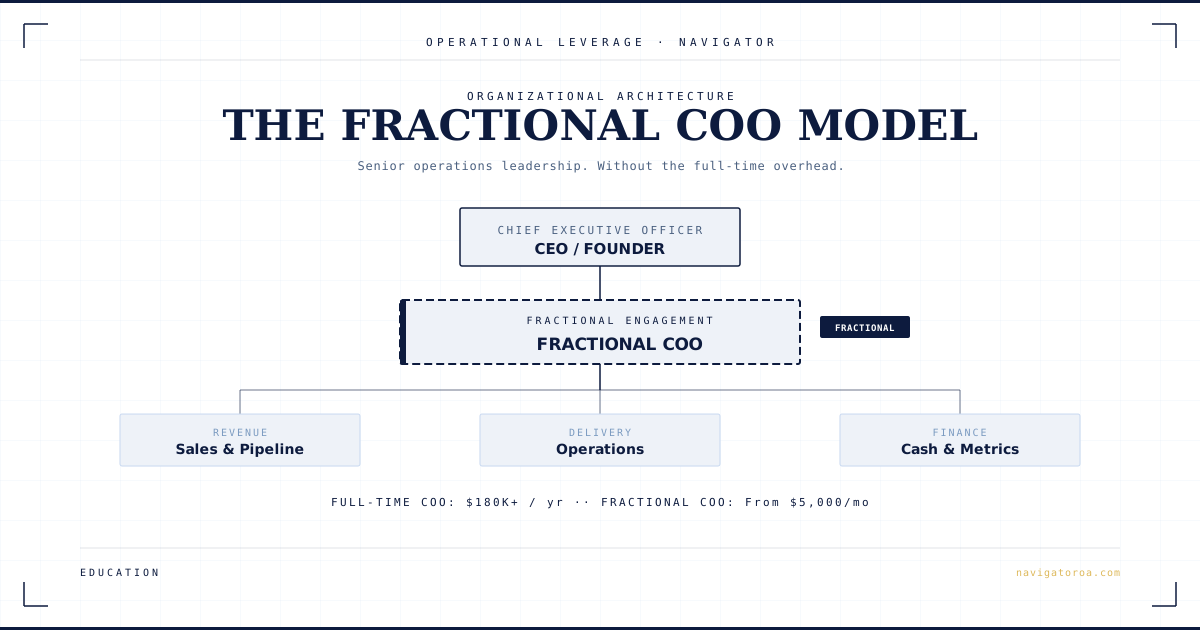
The short answer: an operations consultant in Canada can cost anywhere from a modest monthly retainer to a six-figure annual commitment, and the number you pay depends almost entirely on the pricing model, not the job title. Hourly consultants bill by the hour. Large firms cost the most. Outcome-based fractional engagements sit in the middle and give you the most predictable number. Below, we break down each model and then anchor to the transparent figures Navigator actually publishes.
Most Founders searching for this answer are frustrated for a good reason. The consulting market is deliberately vague about price. Ask three firms what an engagement costs and you will get three non-answers, usually some version of "it depends on scope." So let us start with the honest version of "it depends," because the model you choose changes the math more than anything else.
"The question is never just how much a consultant costs. It is how much a consultant costs relative to the constraint they remove. A cheap consultant who fixes nothing is the most expensive option on the table."
The Three Ways Operations Consultants Charge
There are three dominant pricing structures in the Canadian market, and understanding them tells you most of what you need to know before you ever get on a call.
Hourly consultants. Independent operators and small shops often bill by the hour. The appeal is obvious: you only pay for the time you use. The problem is equally obvious. Hourly billing rewards slowness. The consultant has no structural incentive to move fast, and you have no way to predict the final invoice. A project that "should take a few weeks" can quietly stretch, and every clarifying email becomes billable. Hourly work suits narrow, well-defined tasks. It is a poor fit for the open-ended work of redesigning how a business runs.
Large firms. At the top of the market sit the recognizable consulting firms. They bring brand, bench depth, and polished decks. They also cost the most by a wide margin, and the senior person who sold you the engagement is rarely the person doing the work. For a $1M to $10M Canadian business, this tier usually delivers a strategy document rather than an operating system that runs after the consultants leave. You pay for the logo and the analysis. You often do not pay for implementation.
Outcome-based fractional engagements. Between those two extremes sits the model built for owner-operated businesses: a scoped monthly engagement with a defined outcome and a senior operator doing the actual work. This is where the pricing becomes both transparent and predictable, because you are buying a result over a fixed window, not an open meter.
We deliberately keep the first two categories qualitative here. Anyone quoting you a precise "market rate" for hourly or big-firm work is guessing, because those numbers swing wildly by city, seniority, and scope. What we can be precise about is our own pricing.
What Navigator Actually Charges
Here is the transparent version. A fractional COO engagement with Navigator runs $3,000 to $15,000 CAD per month, scaled to the size and complexity of the business. That single range covers most of what owner-operated companies need, and it exists specifically so you are not left guessing.
Within that band, the work comes in a few defined shapes:
- A build engagement runs $5,000 to $10,000 per month at roughly 10 to 15 hours per week, over a 10 to 16 week window. This is the mode for designing and installing the systems your business is missing.
- An ongoing retainer runs $2,000 to $5,000 per month once the heavy build is done and the work shifts to maintenance, oversight, and steady improvement.
- The 90-Day Reset runs $5,000 to $7,000 per month and exists to stabilize a business that is straining under its own growth.
- A Strategy Map is a fixed $1,500 for owners who want a clear diagnostic and a prioritized plan before committing to anything larger.
Compare that to the alternative most Founders consider first: hiring a full-time COO. A full-time chief operating officer in Canada costs $150,000 to $300,000 per year, which works out to roughly $12,500 to $25,000 per month once you account for salary alone. Add recruitment, which typically runs $20,000 to $50,000 to fill the role, plus the months of ramp time before the hire is productive, and the fractional math starts to look very different. For a deeper breakdown, the fractional COO cost page walks through the full comparison.
Reading about the problem? Score your own operations.
25 checks, 5 pillars, about 7 minutes. Your gaps appear on screen.
Cheap Consultants Are Usually the Expensive Ones
There is a trap worth naming directly. The lowest hourly rate is almost never the lowest total cost.
A consultant who bills by the hour and works slowly, or who diagnoses the wrong constraint, or who hands you a document instead of a working system, can cost more in wasted quarters than a higher-priced operator who removes the actual bottleneck in twelve weeks. The invoice is only one part of the equation. The other part is what the constraint is costing you every month it stays in place: the lost margin, the deals that slip through untracked follow-up, the founder time consumed by decisions that should never reach the founder.
This is why we push Founders to think in terms of the constraint, not the rate. If your business is leaking margin because delivery is inconsistent, the relevant question is not "what is the hourly rate," it is "what would it be worth to make delivery consistent, and how fast can that happen."
Why the Model Matters More Than the Number
Two businesses can spend the identical amount on operations consulting and get wildly different results, because the structure of the engagement determines the incentives.
Hourly billing aligns the consultant's income with elapsed time. Outcome-based engagements align it with the result. When Navigator scopes a build engagement, the number is fixed against a defined outcome and a defined window, which means the incentive is to work efficiently and finish. That single structural difference removes the two things Founders hate most about consulting: the surprise invoice and the endless engagement that never quite ends.
If you have already felt the pain of an hourly relationship that drifted, you are not alone. It is one of the most common reasons owners come to us, and it maps closely to the pattern we described in Why Your CRM Is a Symptom, Not the Problem: the tool or the rate is rarely the real issue. The process behind it is.
How to Budget for It
If you are trying to set a realistic number, start with where your business actually is.
If you have never had an operational diagnosis and you are not sure where your constraint even lives, the Strategy Map at $1,500 is the low-risk entry point. It gives you the map before you spend on the build.
If you already know your systems are the problem and you need them designed and installed, budget for a build engagement in the $5,000 to $10,000 per month range over roughly three to four months. That is the mode that produces the documented, delegatable operating systems most $1M businesses are missing.
If your systems exist but need steady oversight, the retainer band of $2,000 to $5,000 per month is the right frame.
A good operations consultant should be able to tell you, before you commit a dollar, which of these your business needs and why. If they cannot, that is information too.
A Note on Who You Are Buying
Price is only half the decision. The other half is who is actually doing the work and whether they have done it before at your stage.
Navigator has operated since 2002, more than 25 years, and in that time we have worked with over 1,000 leaders. We are based in Sudbury, Ontario, and we have been named Consulting Company of the Year three times by BestRated.ca. We mention this not as a sales line but because tenure is one of the few honest signals in a market that is otherwise hard to evaluate on price alone. The right question is not only "how much," it is "how much, from whom, for what outcome."
The Bottom Line
An operations consultant in Canada costs what the model dictates. Hourly work is unpredictable and rewards slowness. Large firms cost the most and often deliver analysis rather than a running system. Outcome-based fractional engagements give you a predictable monthly number tied to a defined result, which for Navigator means $3,000 to $15,000 CAD per month depending on the shape of the work.
If you want a concrete number for your specific situation, the fastest path is a short conversation where we map your constraint and tell you honestly which model fits.
45 minutes. We map your operational constraint and give you a transparent number, no vague "it depends."
FREE · SCORED ON SCREEN IN ABOUT 7 MINUTES
OPERATIONAL LEVERAGE, WEEKLY DISPATCH
Get frameworks like this every week.
No padding, no filler, just field-tested operational tactics for Canadian Founders.
Prefer LinkedIn? Subscribe to Operational Leverage on LinkedIn.
Where is your business leaking growth?
25 checks across 5 operational pillars. Your score and your gaps appear on screen in about 7 minutes.