Why a Company Needs an Operations Manager and an Operations Architect.
There's a point where your business is growing but everything feels slower, heavier, and more dependent on you than it should. It's not an execution problem. It's a structural one.

Founder & CEO · Navigator · Sudbury, Ontario
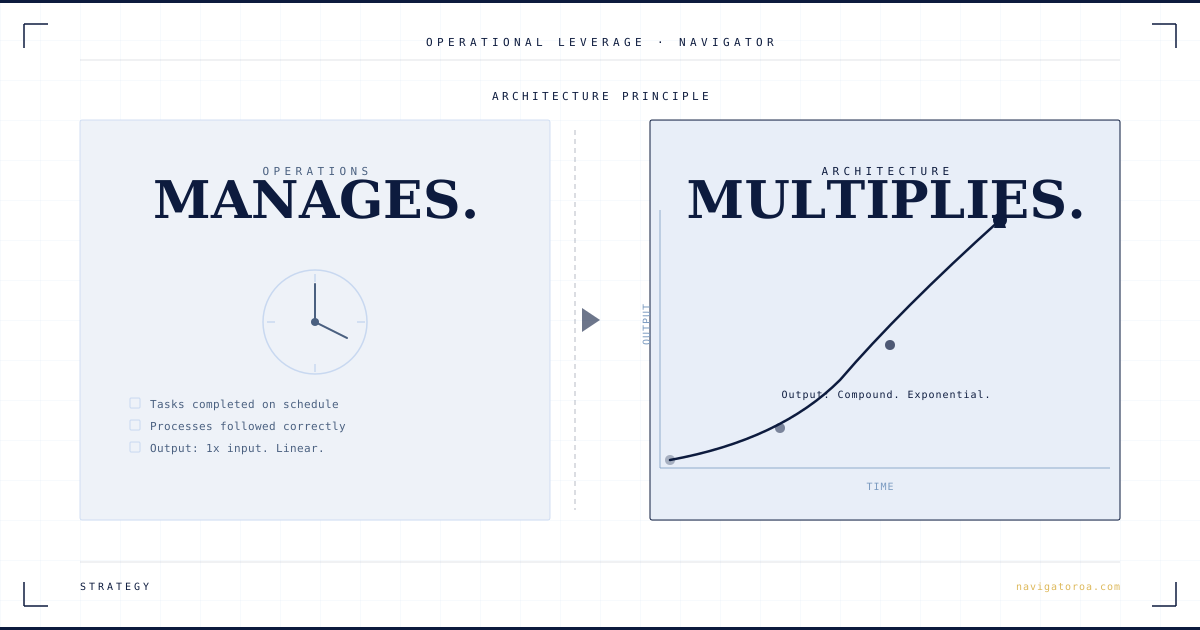
If your business is growing but everything feels slower, heavier, and more dependent, it's not an execution problem. It's a system failure.
When growth begins to strain the business, experienced operators recognize the need for structural redesign, not more effort.
There's a point where your business is growing but everything feels slower, heavier, and more dependent on you than it should.
Not broken. Not failing.
But slower. Less clear. More dependent.
And the first person to feel it, before the Founder fully sees it, is usually the Operations Manager.
The Signal Most Founders Miss
At early stages, strong Operations Managers are the force that keeps everything moving. They:
- Fill gaps
- Coordinate moving parts
- Translate vision into execution
- Keep the team aligned under pressure
They are often the reason the business reaches its next level.
But as the company scales, something shifts.
And experienced operators recognize it early: more effort stops producing better outcomes.
What High-Level Operators See Early
They don't immediately ask for more hires, more tools, or more meetings.
They ask:
- Why does every project feel slightly different?
- Why do decisions keep routing through the same people?
- Why does onboarding take longer than it should?
- Why does the team hesitate without clarity?
They're not looking at tasks. They're seeing structural strain.
Reading about the problem? Score your own operations.
25 checks, 5 pillars, about 7 minutes. Your gaps appear on screen.
Operations Manager vs. Operational Architect
This is where clarity matters. Because these roles are not interchangeable, and expecting them to be creates the bottleneck.
Operations Manager
Manages the business *within* the system.
- Ensures execution happens
- Coordinates people and timelines
- Maintains delivery standards
- Keeps daily operations moving
They are responsible for performance *inside* the structure.
Operational Architect
Designs the system the business *runs on*.
- Builds systems, SOPs, and workflows
- Defines ownership and decision pathways
- Installs execution rhythm
- Aligns operations to revenue flow
They are responsible for the structure itself.
Without an Operational Architect, everything depends on effort. One manages execution. One removes friction from execution.
When they work in isolation, strain builds. When they work in harmony, scale becomes controlled.
Why the Operational Architect Is Typically Brought In Fractionally
This isn't a full-time internal role for most businesses. Because architecture is not constant activity, it's targeted intervention. If you're weighing the options, it helps to understand how a fractional operations architect compares to a fractional COO.
An Operational Architect is typically engaged:
- During growth transitions
- When complexity increases
- When inefficiencies begin compounding
- When scaling exposes structural gaps
They come in, redesign the system, install structure, and step back. The Operations Manager then runs that system.
This model works because:
- You don't carry unnecessary overhead
- You get senior-level structural thinking from an experienced operations consultant when needed
- Your internal team stays focused on execution
It's precision, not permanence.
Where Execution Alone Stops Working
At scale, even strong operators feel friction:
- 1.Inconsistent Processes, Work gets done but differently each time.
- 2.Centralized Decision Pressure, Too many decisions route through too few people.
- 3.Compounding Inefficiencies, Delays, rework, and underutilized capacity begin to stack.
Case Study: The Operator Who Saw It Early
A ~$4.2M agency. Strong team. Growing demand.
The Operations Manager flagged the issue, not workload, but structure.
Symptoms: - Onboarding: 12–15 days - Delivery inconsistency across project managers - Increasing decision dependency - Founder pulled into operations
Intervention: 90-Day Operating Reset
- Rebuilt onboarding system
- Standardized delivery workflows
- Installed communication protocols
- Defined execution rhythm
Results (90 Days): - Onboarding: 12–15 days → 4 days - Capacity utilization: ~65% → 82% - Ops Manager workload down ~30% - Founder removed from majority of delivery decisions
6-Month Impact: - Revenue: $4.2M → $5.1M - No proportional hiring increase
Case Study: The Business That Waited Too Long
A Founder-led e-commerce hybrid business (~$2.8M).
They believed they needed more hires, better marketing, and more tools. They hired 4 people in 5 months. Revenue barely moved.
Why? - No standardized onboarding - Undefined ownership - Constant Slack-based decision making - Ops Manager overwhelmed managing inconsistency
Intervention (Late):
Operational architecture installed after strain peaked.
Results: - Reduced internal communication noise by ~40% - Cut order processing delays by 50% - Eliminated 2 redundant roles created from inefficiency - Restored operational clarity within 60 days
The cost wasn't just inefficiency. It was unnecessary hiring and lost time.
What This Really Means
Strong Operations Managers don't try to carry broken systems. They recognize when the system needs to be rebuilt. They:
- Escalate structural issues early
- Advocate for clarity, not just capacity
- Understand the limits of execution without design
And that decision changes everything.
The Real Risk
If this layer is ignored:
- Hiring increases complexity
- Operators burn out
- Founders get pulled back in
- Revenue slows despite effort
Not because the team is weak. Because the system was never designed to scale.
Final Thought
Scaling doesn't fail at the execution level. It fails at the structural level.
And the strongest Operations Managers know: their role isn't to compensate for broken architecture indefinitely. It's to recognize when it's time to bring in the architecture that allows the business to actually scale.
A Better Question to Leave With
If your business is growing, but feels heavier each month, ask:
- Where are decisions unclear?
- Where is work being interpreted instead of executed?
- Where is capacity being lost inside the system?
- Where are you relying on people instead of structure?
If these questions are surfacing clearly, it's a signal the business has outgrown its current operating structure. That's typically where operational architecture becomes necessary, not optional.
OPERATIONAL LEVERAGE, WEEKLY DISPATCH
Get frameworks like this every week.
No padding, no filler, just field-tested operational tactics for Canadian Founders.
Prefer LinkedIn? Subscribe to Operational Leverage on LinkedIn.
45 minutes. No pitch. We'll map your operational constraint and tell you exactly what it would take to fix it.
FREE · SCORED ON SCREEN IN ABOUT 7 MINUTES
Where is your business leaking growth?
25 checks across 5 operational pillars. Your score and your gaps appear on screen in about 7 minutes.