How to Prepare Your Business to Sell: The Operations Side of Exit-Readiness
Buyers do not pay a premium for a business that depends on you. They pay for one that runs without you. The operational work that makes a company sellable is the same work that makes it scalable, and it starts long before you ever talk to a buyer.

Founder & CEO · Navigator · Sudbury, Ontario
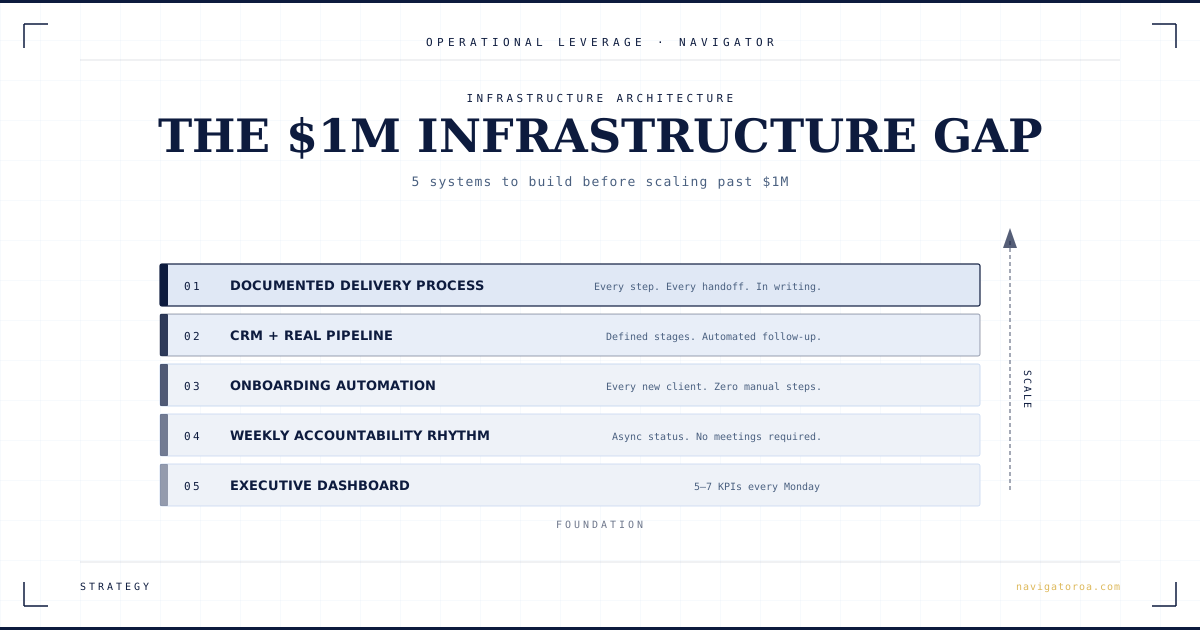
There is a hard truth most owners discover too late: the business you built around yourself is worth less to a buyer than the identical business built around systems. Not because the revenue is different, but because a buyer is not purchasing your revenue. They are purchasing the machine that produces it, and if that machine is you, there is nothing durable to buy.
Preparing a business to sell is usually framed as a financial exercise: clean books, tidy contracts, a good accountant. Those matter. But the part that quietly determines whether a deal closes, and at what terms, is operational. A buyer is asking one question underneath all the others: will this business keep running after the current owner walks out the door? The operational work you do in the years before an exit is what lets you answer yes.
"A buyer is not buying what you do. They are buying what happens when you stop. If the answer is 'everything falls apart,' you have not built an asset. You have built a job that ends when you leave."
Why Founder-Dependency Is the Central Problem
Most owner-operated businesses are, whether the owner sees it or not, organized around the owner. The owner holds the client relationships, makes the judgment calls, enforces quality, and carries the institutional knowledge in their head. This is not a personal failing. It is the natural residue of building something from nothing, where in the early days you had to be everything.
But at the point of sale, that same founder dependency becomes the single largest risk a buyer sees. Every relationship that lives only in your head is a relationship that might leave with you. Every process that only works because you supervise it is a process that might break under new ownership. The buyer prices that risk, and they price it against you.
The reframe is important: founder-dependency is not a flaw in you, it is a removable ceiling on the value of the business. And because it is removable, it is the highest-leverage thing you can work on before an exit.
The Four Things a Buyer Is Actually Evaluating
Underneath the financials, a serious buyer is assessing four operational realities.
Can the business run without the owner? This is the master question. Everything else is a variation of it. A business that survives the owner's two-week absence today is a business that can survive the owner's permanent departure tomorrow. That single capability changes how a buyer perceives risk.
Is the knowledge documented or in someone's head? Buyers pay for transferable knowledge. Documented processes, clear standards, and mapped workflows are assets they can inherit. Undocumented know-how is a liability that evaporates on your last day. This is why SOP development is not administrative busywork, it is value-preservation.
Are the relationships institutional or personal? If your top clients stay because of you specifically, a buyer has to assume some of them leave when you do. If your clients stay because of consistent delivery from a system, the relationships transfer. The more your revenue depends on your personal presence, the more of it a buyer discounts.
Will the business survive due diligence? Due diligence is where deals die. A buyer's team will pull on every thread: how does onboarding actually work, who makes which decisions, what happens when a client complains, where is the process documented. A business held together by improvisation cannot answer these questions cleanly, and every unanswered question becomes either a lower price or a dead deal.
The Operations Audit: 25 questions that reveal how a buyer's due-diligence team would see your business today.
FREE · SCORED ON SCREEN IN ABOUT 7 MINUTES
Reading about the problem? Score your own operations.
25 checks, 5 pillars, about 7 minutes. Your gaps appear on screen.
Documented Systems Raise Value and Survive Due Diligence
The connection between operations and sale price is direct, even though we will avoid quoting any specific valuation figure, because those swing by industry, buyer, and market and anyone quoting you a fixed multiple is guessing.
What is not a guess is the mechanism. Documented systems reduce perceived risk. Reduced risk means a buyer needs less protection, which shows up as cleaner terms, less earn-out contingency, and a smoother close. A business where the systems are written down, the decisions are defined, and the delivery is consistent is a business a buyer can underwrite with confidence. Confidence is what you are really selling.
Documentation also does something specific during due diligence: it lets the business answer its own questions. When the buyer's team asks how something works, you hand them a document instead of scheduling a call where you explain it from memory. Every clean answer builds trust. Every "well, it depends on the situation" erodes it. The businesses that survive diligence intact are the ones that built their systems years before, not the ones scrambling to document in the final ninety days.
The Work Is the Same Work That Makes You Scalable
Here is the part owners find reassuring: exit-readiness is not a separate project you bolt on before a sale. It is identical to the operational maturity that makes a business scalable and livable right now.
The systems that make a business sellable, documented processes, defined decision rights, consistent delivery, visibility that does not depend on the owner, are the same systems that let you grow without burning out, take a real vacation, and stop being the bottleneck. This is why the smartest owners do not wait for a planned exit to do this work. They do it because it makes the business better to own, and the sellability comes free with it.
If you have read our piece on The 5 Systems Every Canadian Business Needs Before Scaling, you already know the sequence. Exit-readiness is that same sequence, viewed through a buyer's eyes.
A Realistic Timeline
The work takes time, which is precisely why it has to start early. You cannot manufacture years of documented, running systems in the quarter before a sale. A buyer can tell the difference between systems that have operated for two years and a binder assembled last month.
If a sale is somewhere on your horizon, even a distant one, the operational preparation should begin now:
- Start by removing yourself from the daily decision path, so the business demonstrably runs without you.
- Document the delivery process end to end, so the knowledge is transferable rather than personal.
- Define decision rights, so authority is institutional rather than gravitating to you.
- Build visibility systems, so performance is legible to someone who did not build the company.
This is exactly the kind of build a fractional COO leads, and the shape of it fits a scoped engagement: a build phase to install the systems, then a lighter retainer to keep them running and refined in the years before you sell.
Start Before You Need To
The cruel irony of exit-readiness is that the owners who most need this work are the ones with the least time to do it, because they are the ones running a business that cannot spare them. The way out is the same as the way up: build the systems that let the business run without you, and you simultaneously make it more valuable, more sellable, and more pleasant to own in the meantime.
Navigator has led this work since 2002, more than 25 years, across over 1,000 leaders, from our base in Sudbury, Ontario. Whether you plan to sell in one year or ten, the operational preparation is the same, and the best time to start it was already a while ago. The second best time is now.
45 minutes. We assess how a buyer would see your operations today and map what to build first.
FREE · SCORED ON SCREEN IN ABOUT 7 MINUTES
OPERATIONAL LEVERAGE, WEEKLY DISPATCH
Get frameworks like this every week.
No padding, no filler, just field-tested operational tactics for Canadian Founders.
Prefer LinkedIn? Subscribe to Operational Leverage on LinkedIn.
Where is your business leaking growth?
25 checks across 5 operational pillars. Your score and your gaps appear on screen in about 7 minutes.