How to Scale a Service Business in Canada Past $1M, Without Burning Out
Most Canadian Founders hit a wall between $750K and $1.5M in revenue. It's not a market problem. It's an infrastructure problem. Here's what to build before you push harder on growth.

Founder & CEO · Navigator · Sudbury, Ontario
There is a revenue range that breaks Canadian Founders more reliably than any market downturn or competitive threat: $750K to $1.5M.
At this stage, you've proven the model. You have clients. You have a team, or the beginning of one. Revenue is growing. And yet everything feels harder, not easier. You're working more hours than you did when you started. Your team can't seem to execute without you. Quality is inconsistent. Clients are asking questions you used to have time to answer.
This is not a growth problem. This is an infrastructure problem.
"You're running a $1M business on $200K infrastructure, and you can feel every dollar of the gap."
The Founders who push through this stage cleanly, who go from $1M to $3M without destroying their health or their margins, all have one thing in common: they built the right systems before they needed them.
Why Service Businesses Stall at $1M in Canada
The Canadian market has some specific characteristics that make this inflection point particularly sharp. Unlike US markets where venture funding can paper over operational constraints, most Canadian service businesses are bootstrapped or lightly funded. That means your margin is the only buffer you have between growth and burnout.
And most service businesses at $1M are running on these five operational holes:
- No defined delivery process, every project is improvised based on who's available
- Founder as the approval bottleneck, nothing ships without your sign-off
- No CRM or pipeline visibility, revenue is a surprise, not a forecast
- Zero automation, every client communication, onboarding step, and follow-up is manual
- No team accountability system, you manage by presence, not by metrics
These five gaps are manageable when you're doing $400K. At $1M+, each one costs you money, margin, and hours every single week.
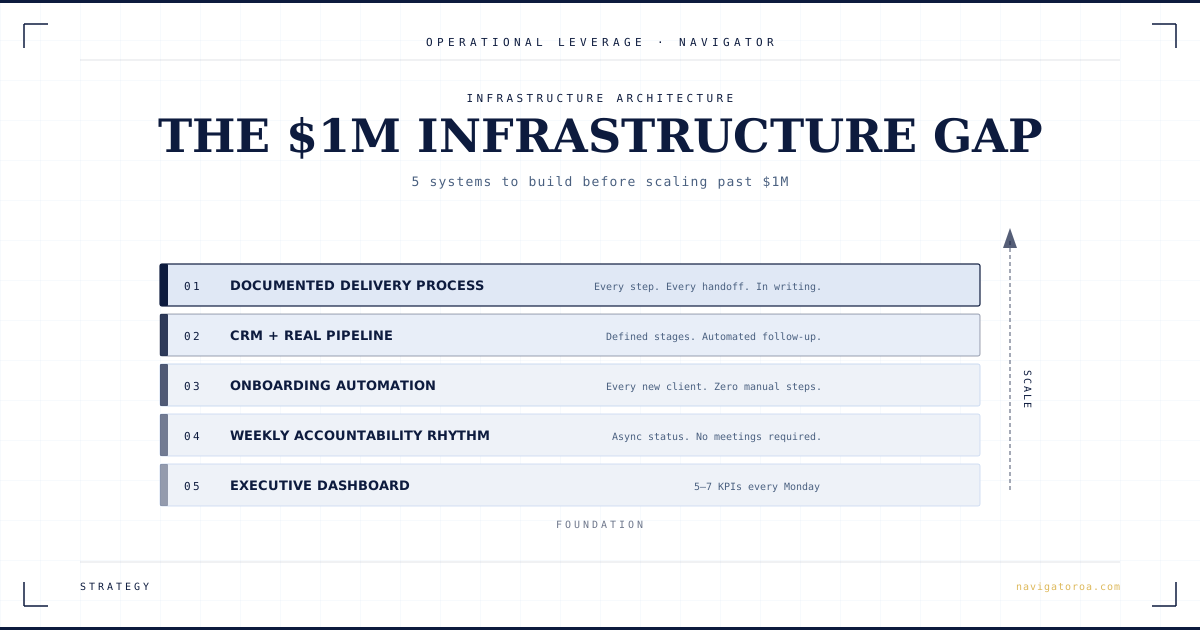
The Five Systems to Build Before You Scale
This isn't a list of software tools. It's a list of operational infrastructure, the underlying logic that your tools then execute on.
1. A documented delivery process
Write down exactly how you deliver your core offer from signed contract to delivered outcome. Every step. Every decision point. Every handoff. This is your first SOP, and it is the foundation of every hire you'll ever make. You cannot train someone to do what you've never written down.
2. A CRM with a real pipeline
Not a spreadsheet. A CRM with defined stages, stage-change criteria, and automated follow-up sequences. At $1M+ you should never forget to follow up with a prospect. That's an automation problem, not a discipline problem.
The Operations Audit, 25 questions that reveal exactly where your business is leaking growth
FREE · SCORED ON SCREEN IN ABOUT 7 MINUTES
3. An onboarding automation
Every new client should trigger an automated sequence: welcome email, intake questionnaire, folder creation, kickoff meeting booking. If you're doing this manually for every client, you're spending 2–4 hours per onboarding that should take zero.
4. A weekly accountability rhythm
Not a daily standup. A weekly async status update from every team member, reviewed by you in 20 minutes on Monday morning. The moment your team can update you without a meeting, you've bought back 3–5 hours per week.
5. A simple executive dashboard
Five to seven numbers you check every Monday before you open your email: revenue run rate, pipeline value, cash in bank, client health score, team utilization. If you don't have these numbers at your fingertips, you're flying the business blind.
OPERATIONAL LEVERAGE, WEEKLY DISPATCH
Get frameworks like this every week.
No padding, no filler, just field-tested operational tactics for Canadian Founders.
Prefer LinkedIn? Subscribe to Operational Leverage on LinkedIn.
Reading about the problem? Score your own operations.
25 checks, 5 pillars, about 7 minutes. Your gaps appear on screen.
What Building These Systems Actually Gives You
Most Founders resist building systems because it feels like admin, like taking time away from "real work." But consider what each system actually returns:
- Documented delivery process → your next hire is productive in 30 days instead of 90
- CRM and pipeline → you stop losing deals to forgotten follow-ups
- Onboarding automation → 3–4 hours back per client onboarded
- Weekly accountability rhythm → you stop managing by being present
- Executive dashboard → you make faster, better decisions with less cognitive load
Founders who build these five systems before they push hard on growth scale to $3M. Founders who don't spend another two years stuck at $1.2M, wondering why more revenue isn't making things easier.
The Canadian Context
One thing that makes this conversation specifically important for Canadian Founders: we don't have the same safety nets as Founders in larger markets. If your operations break under growth pressure, you don't have a Series A to hire your way out of the problem.
The Founders who build great Canadian businesses build operational infrastructure first. They treat their business like an architect would, design the structure before you pour the concrete.
The Pre-Scale Foundations Blueprint, the 5 systems every sub-$1M Canadian Founder needs before their next dollar of growth
FREE · SCORED ON SCREEN IN ABOUT 7 MINUTES
The Fastest Path Through the Wall
If you're stuck between $750K and $1.5M and it feels like you're pushing against a ceiling, the fastest path through is not more sales activity. It's an honest operational audit, ideally guided by an operations consultant, a two-week diagnostic that tells you exactly which systems to build first, in what order, with what resources.
That's exactly what Navigator's Operations Audit delivers. And it starts with a 30-minute strategy call where we listen to your situation and tell you honestly whether we can help.
Where is your business leaking growth?
25 checks across 5 operational pillars. Your score and your gaps appear on screen in about 7 minutes.