Strategic Plan vs Operational Plan: Which One Your Business Is Missing
A direct answer up front: a strategic plan defines where you are going, an operational plan defines how you get there, and most businesses have some version of the first and almost none of the second. That gap is exactly why strategy stalls.

Founder & CEO · Navigator · Sudbury, Ontario
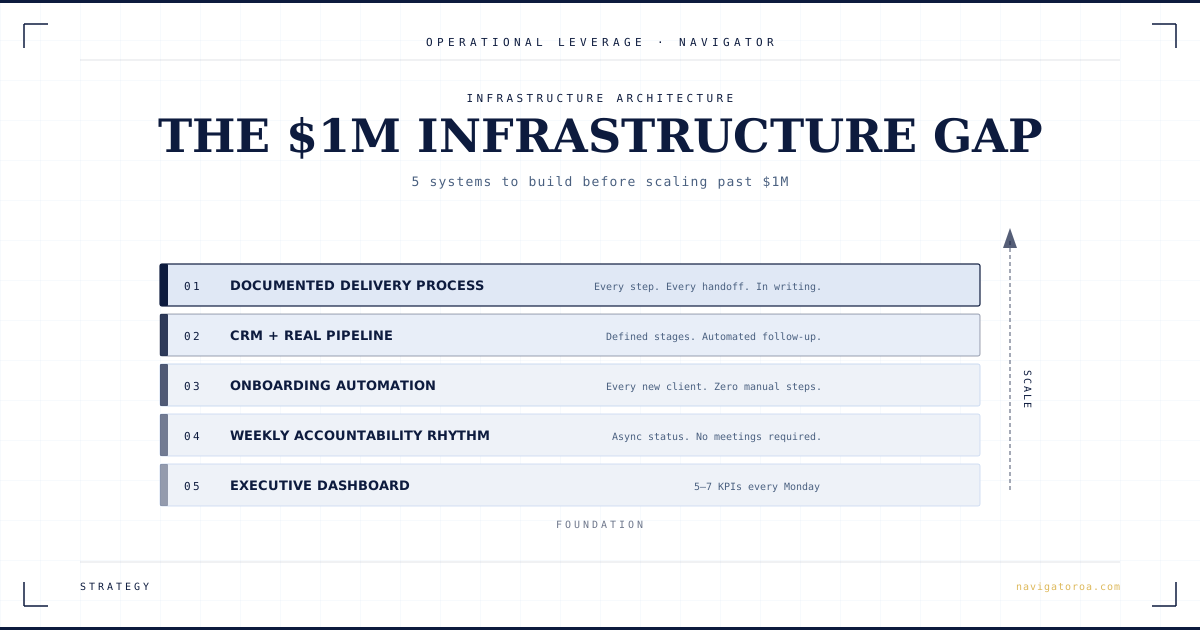
Here is the short version: a strategic plan defines where your business is going and why, while an operational plan defines how it actually gets there. Most businesses have some version of the strategic layer, a set of goals, a direction, a rough idea of the next few years, and almost none of the operational layer. That gap is the single most common reason strategy stalls, and it is almost always the missing half.
If you have ever left a planning session energized, written down the priorities, and then watched the business drift right back to running the way it always did, you have felt this gap firsthand. The plan was not wrong. It was just incomplete. Direction without an operating system to carry it is a wish, not a plan.
"A strategic plan tells you where to go. An operational plan is the machine that gets you there. Without the second one, the first is just a document."
What a Strategic Plan Actually Is
A strategic plan answers two questions: where are we going, and why? It sets direction over roughly one to three years, names the few outcomes that matter most, and forces trade-offs about what you will and will not pursue.
Done well, a strategic plan is short. It names a small number of priorities, ideally three to five, and makes clear what the business is optimizing for. Revenue growth, margin, a new market, reduced founder dependency: the strategy is the choice of which mountain to climb.
The strategic layer is where most owners are comfortable. You know your market. You have instincts about where the opportunity is. The problem is rarely a lack of direction. The problem is that direction, on its own, changes nothing about how Monday actually runs.
What an Operational Plan Actually Is
An operational plan answers three different questions: how, who, and when? It turns direction into daily execution. Where the strategic plan says "reduce our reliance on the founder," the operational plan says which systems get built, in what order, who owns each one, and what metrics prove it is working.
The operational layer is concrete:
- Systems. The documented processes, SOPs, tools, automations, and dashboards the strategy requires.
- Owners. A named person accountable for each priority, with the authority to actually move it.
- Sequence. What gets built first, second, and third, ordered by leverage.
- Metrics. The handful of numbers that show whether the plan is working before it is too late to adjust.
This is the layer almost every $500K to $15M+ business is missing. Not because owners do not know it matters, but because building it is slower and less exciting than setting direction, so it perpetually loses to the urgent work of the week.
Reading about the problem? Score your own operations.
25 checks, 5 pillars, about 7 minutes. Your gaps appear on screen.
Why the Gap Exists
The gap between strategy and operations is not a discipline problem. It is a structural one.
At the early stage, the founder is the operational plan. You hold the priorities in your head, you make the decisions, you enforce the standard, and execution happens because you personally drive it. This works, right up until the business gets big enough that you cannot personally drive everything. At that point the strategic plan and the founder's daily involvement are the only two things holding the business together, and neither of them scales.
This is the same pattern behind founder dependency: the business runs on one person's presence rather than on systems. A strategic plan does not fix that. If anything, an ambitious strategy with no operational plan makes founder dependency worse, because it loads more onto the one person the whole operation already routes through.
"Most strategic plans fail because they are documents, not systems. The plan had no owner, no sequence, and no connection to the systems that run the day-to-day."
How to Tell Which One You Are Missing
Run this quick diagnostic. If you can answer the first set of questions but not the second, you have a strategic plan and no operational plan, which describes most businesses at this stage.
The strategic questions: Do you know your top three priorities for the next year? Do you know why they matter more than the alternatives? Could you state, in one sentence, what the business is optimizing for?
The operational questions: For each of those priorities, is there a named owner other than you? Is there a defined sequence of what gets built first? Are there systems, not just intentions, that carry the priority without your daily involvement? Is there a metric you review that tells you whether it is working?
If the strategic answers are yes and the operational answers are no, the missing half is clear. You do not need more strategy. You need the operating system that executes the strategy you already have.
Bridging the Two: A Plan That Ends in a Build
The fix is to stop treating strategy and operations as two separate projects separated by months of inertia. Treat strategic planning as the first step of a build.
That is exactly how Navigator's Strategy Map diagnostic works. It is a fixed $1,500 engagement that sets direction and then returns an operating blueprint: the systems to build, the owners, the sequence, and the metrics. It is strategic planning that ends in something you can execute, not a slide deck you file away.
From there, if you choose to install the plan, the build runs 10 to 16 weeks from kickoff to handover: roughly two weeks of audit, one week for the blueprint, six to twelve weeks of building the systems, and a final handover with team training. Direction and execution on one continuous path, so the strategy survives contact with reality.
This is the difference between advising and building, and it is the same principle behind the systems every Canadian business needs before scaling. Strategy points at the destination. Systems are the vehicle. You need both, and you need them connected.
Where to Start
If both plans feel thin, start with direction. Get clear on the three to five priorities that actually matter, and be honest about the trade-offs.
If you have the direction but it keeps stalling, the missing half is operational, and that is the more common and more expensive gap. The lowest-risk way to close it is a focused diagnostic that ends in a build plan rather than another document. A $1,500 Strategy Map gives you a clear picture of where you are going, where the operation is blocking it, and a prioritized sequence of what to build first.
Navigator has done this work since 2002, more than 25 years, across over 1,000 leaders, from Sudbury, Ontario, serving businesses Canada-wide. If your strategy keeps dying in execution, the problem is not the strategy. It is the operational plan you never got to build.
45 minutes. We map where your plan keeps stalling and whether a $1,500 Strategy Map is the right first step.
FREE · SCORED ON SCREEN IN ABOUT 7 MINUTES
OPERATIONAL LEVERAGE, WEEKLY DISPATCH
Get frameworks like this every week.
No padding, no filler, just field-tested operational tactics for Canadian Founders.
Prefer LinkedIn? Subscribe to Operational Leverage on LinkedIn.
Where is your business leaking growth?
25 checks across 5 operational pillars. Your score and your gaps appear on screen in about 7 minutes.