What Is a Fractional COO? (And Does Your Canadian Business Actually Need One?)
Fractional COO is one of the most searched terms by Canadian Founders between $1M and $10M. Here's what it actually means, what it costs, and how to know if it's the right move for your business right now.

Founder & CEO · Navigator · Sudbury, Ontario
If you've been googling "fractional COO" at 11pm after a brutal operational week, you're in good company. It's one of the fastest-growing searches among Canadian Founders in the $1M to $10M revenue range.
But there's a lot of noise in this space. So let's be precise about what a Fractional COO actually is, what they actually do, and, critically, whether your business needs one right now or needs something different.
What Is a Fractional COO?
A COO, Chief Operating Officer, is the person responsible for making sure your business runs. Where the CEO is focused on strategy, vision, and external relationships, the COO is focused on internal execution: systems, processes, team performance, delivery, and operational efficiency.
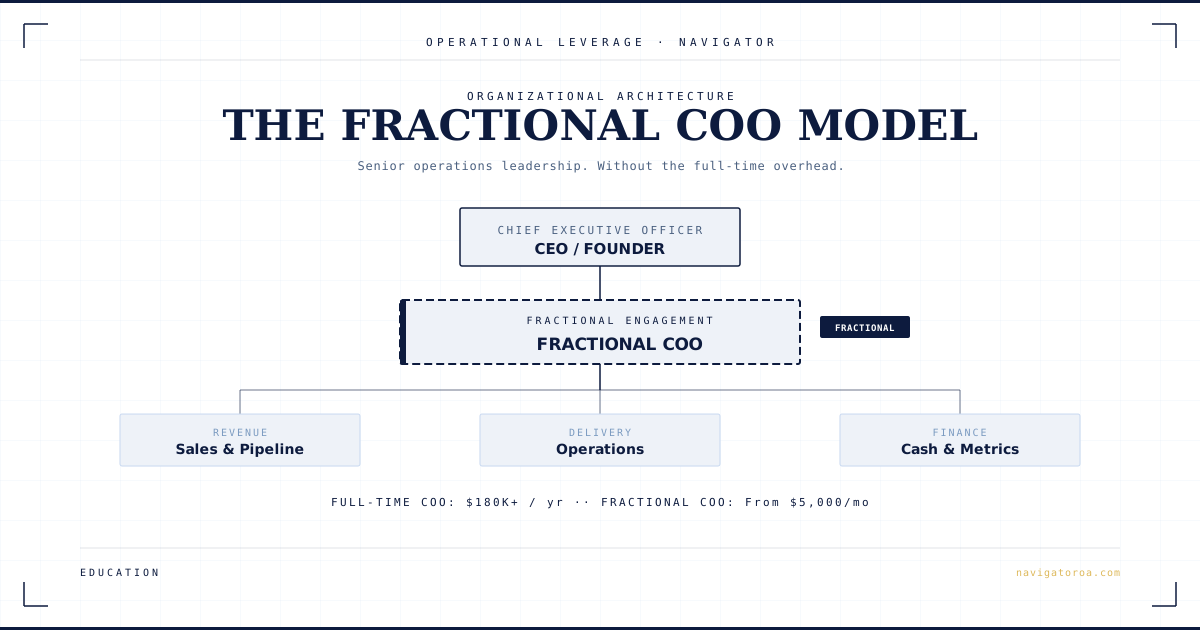
A Fractional COO provides that same senior operations leadership on a part-time or contract basis, typically 10 to 20 hours per week, without the cost or commitment of a full-time executive hire.
In Canada, a full-time COO for a $2M–$10M business typically costs between $150,000 and $300,000 CAD annually in total compensation. A fractional arrangement typically runs $3,000 to $15,000 CAD per month, depending on scope, and it's worth understanding what a fractional COO actually costs before you commit.
"The fractional model gives you a senior operator's judgment without a senior operator's overhead. For most Canadian Founders at the $1M–$5M stage, that's the right trade."
Fractional COO vs. Fractional Operations Architect, What's the Difference?
This distinction matters, and it's one most articles about fractional COOs gloss over.
A Fractional COO typically: - Manages existing people and processes - Sits in leadership meetings and makes operational decisions - Oversees day-to-day execution - Is focused on running what exists
A Fractional Operations Architect (what Navigator provides) typically: - Designs and builds the operational infrastructure itself - Creates the systems, automations, SOPs, and dashboards your business needs - Is focused on building what doesn't exist yet - Exits with full documentation and a trained team
If your business has solid operations and just needs senior leadership to manage them, you want a Fractional COO, and it's worth weighing the fractional COO versus full-time COO decision. If your business needs operational infrastructure built from scratch, systems, processes, automations, you want a Fractional Operations Architect.
Most businesses at the $1M–$5M stage need the latter. The infrastructure doesn't exist yet.
The Operations Audit, find out exactly what's missing in your operational architecture
FREE · SCORED ON SCREEN IN ABOUT 7 MINUTES
Reading about the problem? Score your own operations.
25 checks, 5 pillars, about 7 minutes. Your gaps appear on screen.
How Do You Know If You Need One?
These are the clearest signals your business needs fractional operations leadership:
- You are the approval bottleneck. Projects stall when you're unavailable. Your team cannot make decisions without escalating to you.
- Delivery is inconsistent. Client outcomes depend on who's handling the work, not on a documented process.
- You've tried to delegate and it didn't work. You handed off responsibility without handing off the decision authority or the systems to execute.
- Revenue is growing but margin is shrinking. More clients, more constraints, less profit per dollar of revenue.
- You can't take two weeks off without things breaking. The business requires your daily operational presence to function.
If three or more of these are true, you have an operational infrastructure problem. A fractional operator is the fastest way to solve it.
What Industries Does This Work For?
Operations problems are industry-agnostic. We've seen the same bottlenecks, Founder dependency, inconsistent delivery, absent systems, in:
- Professional services firms (legal, accounting, consulting)
- Agencies (marketing, creative, digital)
- Construction and trades companies
- Healthcare and wellness practices
- SaaS and tech companies
- E-commerce operations
- Government contractors
The specific systems look different. The underlying problem is the same.
OPERATIONAL LEVERAGE, WEEKLY DISPATCH
Get frameworks like this every week.
No padding, no filler, just field-tested operational tactics for Canadian Founders.
Prefer LinkedIn? Subscribe to Operational Leverage on LinkedIn.
What to Expect From a Fractional Operations Engagement
A well-structured fractional operations engagement has four phases:
Phase 1: Reconnaissance (Weeks 1–2) A deep audit of your systems, workflows, team structure, and bottlenecks. The output is a clear diagnosis of your highest-leverage constraints.
Phase 2: Blueprint (Week 3) A full architectural plan, what to build, in what order, by what deadline, with what resources. No vague recommendations. Specific, prioritized actions.
Phase 3: Construction (Weeks 4–14) Active building. Systems, automations, SOPs, dashboards. Weekly visible progress. Your team gets trained as we build, so adoption is built in.
Phase 4: Handover (Weeks 15–16) Full documentation, trained staff, and a clean exit. The business runs without us. That's the goal from day one.
Is a Fractional COO Right for You Right Now?
The honest answer: it depends on your constraint.
If your biggest problem is sales, leads, conversion, pipeline, you don't need an operations architect yet. Fix revenue first.
If your biggest problem is delivery, team capacity, Founder time, or operational consistency, and you're generating at least $500K in annual revenue, a fractional operations engagement will likely pay for itself within the first 90 days.
Common Questions, Fractional COO, operations architecture, costs, and process for Canadian businesses
FREE · SCORED ON SCREEN IN ABOUT 7 MINUTES
The fastest way to find out if we're the right fit is a 30-minute strategy call. No pitch. Just an honest conversation about your situation.
Where is your business leaking growth?
25 checks across 5 operational pillars. Your score and your gaps appear on screen in about 7 minutes.