What Problems Can a Fractional Operations Manager Solve in a Growing Business?
Why scaling companies bring in Fractional Operations Managers to eliminate execution bottlenecks, reduce operating costs and turn strategic priorities into measurable results.

Founder & CEO · Navigator · Sudbury, Ontario
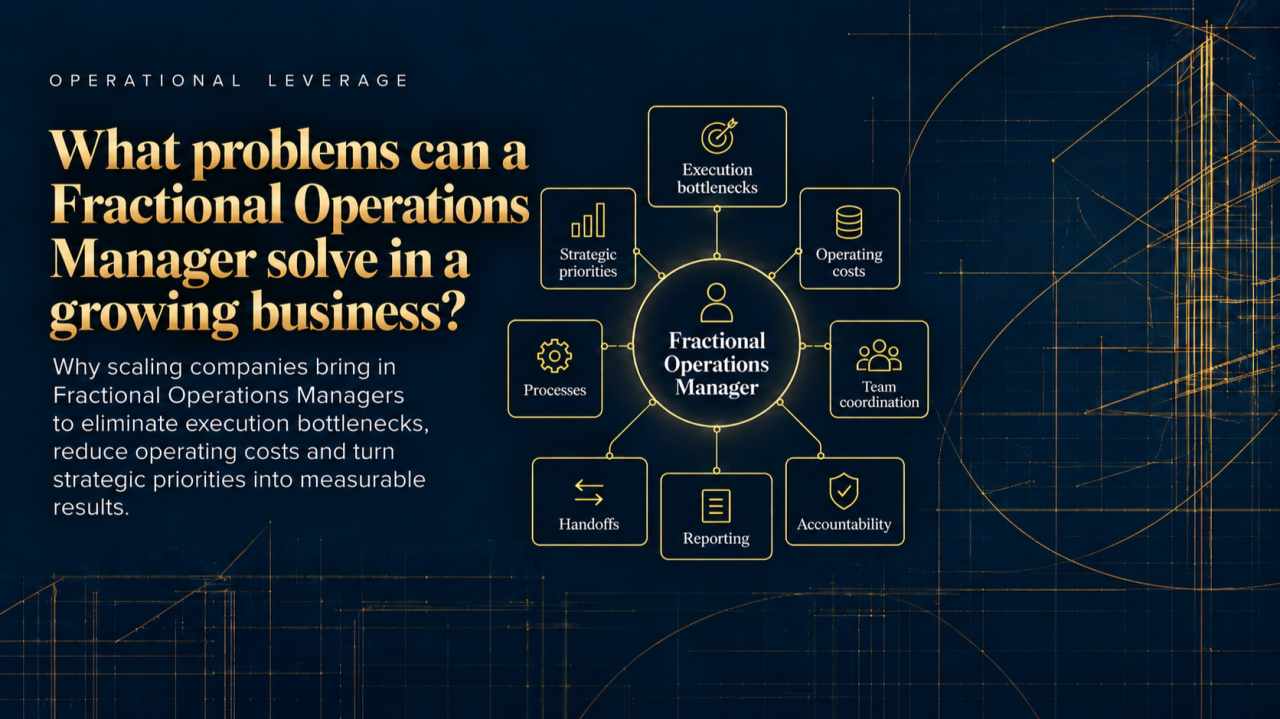
Why scaling companies bring in Fractional Operations Managers to eliminate execution bottlenecks, reduce operating costs and turn strategic priorities into measurable results.
The Pattern I Keep Seeing
Revenue is growing. The company has hired more employees. Department managers are in place. The founder has a strategic plan and ambitious growth objectives. Yet the organization is becoming increasingly difficult to manage. Decisions still reach the founder's desk. Projects move forward, but deadlines slip. Employees ask questions that should already have documented answers. Managers spend increasing amounts of time resolving problems between departments. And despite rising revenue, operating margins are not improving as expected. The founder's first instinct is often to hire another manager. Sometimes that is necessary. But in many scaling businesses, the problem isn't a shortage of managers. It's the absence of someone accountable for how the entire business operates. That's where a Fractional Operations Manager can create significant value.
What Founders Usually Think They Need
When execution problems begin accumulating, founders often diagnose the symptoms rather than the structure behind them. Sales are inconsistent, so they invest in more marketing. Employees make repeated mistakes, so they introduce additional training. Projects fall behind, so they hire another coordinator. The founder feels overwhelmed, so they delegate more responsibilities. But each decision addresses one part of the organization. Nobody is examining how those parts work together. A sales team can exceed its targets while operations struggles to deliver the additional work. A project manager can meet internal deadlines while purchasing delays create avoidable costs. A new employee can be capable and motivated but underperform because onboarding procedures are incomplete. These aren't necessarily individual performance failures. They are often failures of operational design. Adding people to a company without fixing its operating structure can increase coordination costs rather than productive capacity.
Reading about the problem? Score your own operations.
25 checks, 5 pillars, about 7 minutes. Your gaps appear on screen.
What a Fractional Operations Manager Actually Does
A Fractional Operations Manager is an experienced operations professional who works within a business on a part-time or defined engagement basis. Unlike a consultant who delivers recommendations and leaves implementation to others, an embedded fractional operator takes responsibility for installing agreed processes, coordinating execution and establishing management accountability. The role can include: - Translating strategic and business plans into operational priorities. - Clarifying departmental responsibilities and decision authority. - Documenting standard operating procedures. - Establishing employee onboarding and training infrastructure. - Creating consistent weekly and monthly execution rhythms. - Identifying workflow bottlenecks and recurring operational costs. - Introducing performance indicators and management reporting. - Improving coordination between sales, operations, finance and employees. The precise responsibilities depend on the company's size, management capacity and existing systems. A Fractional Operations Manager does not replace every department manager. Instead, the role helps ensure those managers have the structure, information and accountability required to perform effectively. The objective is not to create another management layer. It is to make the existing organization function more effectively. Consider a founder who approves every purchasing exception. A Fractional Operations Manager can introduce approval thresholds, documented purchasing procedures and clear escalation rules. Routine decisions move to authorized managers. The founder becomes involved only when an issue exceeds the agreed threshold or requires strategic judgment. The benefit is not simply fewer interruptions. It is an organization developing the ability to operate without every decision returning to one person.
Protecting Project Margins Undocumented project scopes, unclear responsibilities and preventable rework make profitability harder to manage. A healthy sales pipeline does not resolve those operating problems. A Fractional Operations Manager can standardize project intake, clarify handoff responsibilities, establish approval thresholds and document recurring tasks. Project managers can then review margins, employee capacity and execution obstacles against agreed indicators. The work also includes purchasing controls, vendor responsibilities and a consistent process for approving scope changes. These controls help teams identify where work is exceeding the agreed scope and where administrative effort is being duplicated. Financial performance should be assessed using the business's own project costs, rework records and margin data, with management and implementation costs included. ## Reducing Founder Dependency in Distribution and E-commerce Growing order volumes create pressure when the founder still approves purchasing exceptions, resolves warehouse issues, reviews customer escalations and answers routine questions about responsibilities. When decision rights and procedures are unclear, the business depends on the founder's availability rather than a repeatable operating process. A Fractional Operations Manager can define purchasing authority, document warehouse and fulfilment handoffs, establish customer escalation rules and introduce management reporting. The operational focus includes inventory and purchasing control, avoidable overtime, fulfilment errors and repeated customer-service corrections. Clear ownership allows managers to handle routine work within agreed limits and bring exceptions to leadership with the information needed for a decision. Founder involvement and operating costs should be measured separately. Time available for leadership is not automatically a cash saving. ## The Problems That Should Reach Management Earlier
Some of the most expensive operational problems begin as minor employee frustrations. A supplier regularly delivers incorrect quantities. A new employee cannot find the correct procedure. Customer handoffs are inconsistent. A sales representative repeatedly waits for pricing approval. A project coordinator spends hours correcting information that should have been captured correctly at intake. Individually, these issues may not appear significant. But when they recur across weeks, employees and departments, they begin affecting capacity, profitability and customer experience. The underlying problem is often that no one is looking across the entire operating system. A Fractional Operations Manager establishes a process for identifying and escalating recurring friction. That may involve weekly operational reviews, employee feedback, exception tracking, KPI dashboards and corrective-action registers. For example, a repeated customer handoff problem should not generate another round of reminders telling employees to communicate better. Management should investigate the actual workflow. Who owns the handoff? What information must be transferred? Where is it recorded? What happens when required information is missing? Who is accountable for correcting the process? A documented handoff procedure, an assigned owner and an exception-review rhythm can address the structural cause. The goal is not simply to resolve today's problem. It is to prevent the same problem from consuming management time next month. This is also where consistent monthly business intelligence becomes valuable. In the previous issue of Operational Leverage, we examined how centralized reporting can help management identify operational obstacles earlier. But visibility creates another question. Once the problem becomes visible, who is accountable for ensuring it gets fixed? A Fractional Operations Manager can help close that gap between operational intelligence and actual execution.
How Navigator OA Approaches the First 90 Days
When Navigator OA enters a growing organization, the first priority is not to introduce more meetings, rewrite every procedure or purchase new software. It is to understand where the existing operating system is failing to support the company's objectives. Our 90-Day Operating Reset™ brings together six interconnected areas: Revenue Architecture Clarity, Documented Systems and SOP Framework, Execution Rhythm Installation, Onboarding Infrastructure, Founder Time Optimization and Measurable Revenue Control. The work follows three practical stages.
First 30 Days: Diagnose the Operating Constraints
We examine how work moves through the organization. Where are decisions getting delayed? Which processes depend unnecessarily on the founder? Where are departments working with incomplete information? Which recurring problems are affecting costs, customer delivery or employee capacity? We also review the connection between the business plan, strategic objectives, departmental responsibilities and current performance indicators. The objective is to identify a focused set of structural constraints rather than produce an overwhelming catalogue of recommendations.
Days 31–60: Install the Operating Structure
The next stage focuses on implementing the changes with the greatest operational leverage. These may include decision-rights frameworks, standard operating procedures, consistent project handoffs, management reporting, onboarding processes and clear accountability for recurring work. The emphasis is practical. Who owns the process? What does successful execution look like? How is progress measured? When should a problem be escalated? The systems must be usable by employees and managers, not simply documented in a manual.
Days 61–90: Stabilize Execution and Management Accountability
The final stage establishes a repeatable operating rhythm. Managers review performance against relevant KPIs. Operational obstacles are assigned owners and corrective actions. Leadership reviews exceptions requiring cross-departmental decisions. Employees have clearer procedures and reporting expectations. The founder begins to see which responsibilities can remain with managers without constant personal intervention. Not every operational issue will be solved in 90 days. But the objective is to install an operating foundation that can continue supporting execution after the initial reset. An effective operating system should become part of how the company works, not another project that disappears when the engagement ends.
The Diagnostic: Does Your Business Need Fractional Operational Leadership?
Before hiring another manager or restructuring a department, I would ask five questions. 1. Are too many routine decisions still reaching the founder? If employees and managers regularly wait for founder approval, decision authority may be insufficiently defined. 2. Do recurring problems move between departments without anyone owning the underlying solution? This often indicates weak cross-functional accountability. 3. Are managers spending more time coordinating work than improving performance? Increasing management activity without corresponding execution improvements can signal structural friction. 4. Can employees consistently find the procedures, information and training needed to complete their work? If not, onboarding and documentation may be limiting productivity. 5. Can leadership connect operational performance to revenue, margin, capacity and strategic priorities every month? If those relationships are unclear, management may be responding too late to emerging problems. Answering yes to several of these questions does not automatically mean you need a permanent Chief Operating Officer or another full-time senior hire. It may indicate that the company needs experienced operational leadership to design and install the systems its current management team lacks the time or capacity to build.
The Real Value of Fractional Operational Leadership
The strongest financial argument for a Fractional Operations Manager is not that a part-time operator costs less than a full-time executive. That may be true in some circumstances, but cost comparison alone misses the purpose of the engagement. The real question is what operational capability the company currently lacks. Can managers execute priorities without constant founder involvement? Are processes repeatable? Are responsibilities clear? Can employee challenges be identified and resolved before they spread? Is management able to connect the work being performed with financial results? A business may have capable managers in every department and still lack someone responsible for how those departments function together. That is the gap fractional operational leadership is designed to address. The measurable value may appear in reduced rework, stronger margins, fewer errors, better capacity utilization, clearer accountability and recovered founder time. The longer-term value is a business less dependent on individual memory, informal communication and constant executive intervention. Growth does not become easier simply because the company gets bigger. It becomes more manageable when the operating structure evolves with the business.
A Conversation Worth Having
If your business is generating more revenue but becoming harder to manage, the answer may not be another hire. And it may not be another software platform. The first question is whether the organization has the operational structure required to execute its current strategy. A Fractional Operations Manager can help identify the bottlenecks, install the missing systems and establish accountability without requiring the business to immediately build a full-time executive operations function. But this approach is not right for every company. It is most relevant when a business has reached sufficient complexity that informal coordination is no longer reliable and leadership is prepared to change how work is managed. Here is the question I would leave with every founder and CEO: If you stepped away from daily operations for the next 30 days, would your managers have the systems, authority and information needed to keep the company executing against its strategic plan? Or would decisions begin accumulating until you returned? That distinction reveals whether the business has developed operational independence, or simply become more dependent on the person leading it. If you're a founder or CEO dealing with recurring execution bottlenecks, increasing management demands or a business that still depends too heavily on you, send me a message about a Reset Mapping conversation. We'll identify where operational structure, accountability and execution may be limiting performance and whether fractional operational leadership is the right solution. Next in Operational Leverage: Why Hiring Another Manager Doesn't Always Reduce the Founder's Workload and the operating structure required before additional people create real capacity.
Where is your business leaking growth?
25 checks across 5 operational pillars. Your score and your gaps appear on screen in about 7 minutes.