The 5 Systems Every Canadian Business Needs Before Scaling Past $1M
Before you hire another salesperson or open a new market, you need these five operational systems in place. Without them, growth creates constraints. With them, growth compounds.

Founder & CEO · Navigator · Sudbury, Ontario
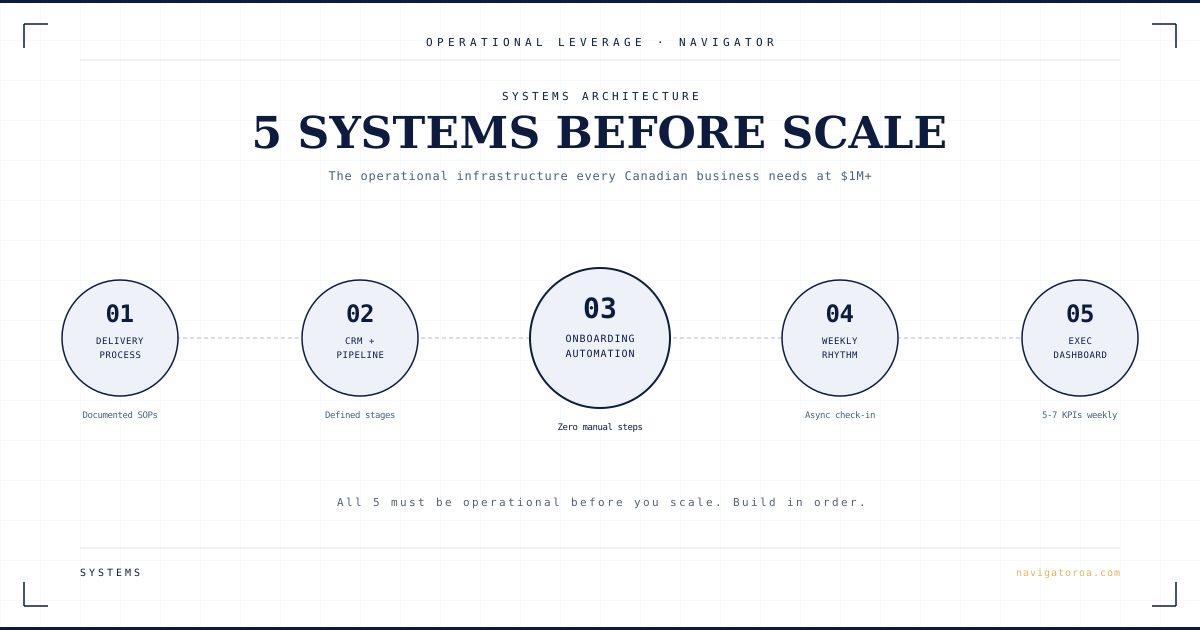
There is a sequence to scaling a business correctly. Most Founders skip it, not because they're careless, but because in the early stages, hustle and sales momentum mask the absence of operational infrastructure.
Then you hit $800K. Or $1M. Or $1.5M. And the absence of those systems starts costing you more than the revenue you're generating.
This is the article I wish existed when Navigator started working with scaling Canadian Founders. These are the five systems, not tools, systems, that separate businesses that scale cleanly from businesses that scale chaotically.
"Systems don't make you less entrepreneurial. They make you entrepreneurially sustainable."
System 1: A Documented Delivery Process
This is the first system and the most frequently skipped. Write down, in explicit numbered steps, exactly how your business delivers its core offer, from signed contract to delivered outcome.
Not a general description. Specific steps. Who does what. In what order. With what inputs. Producing what outputs. Handed to whom.
This document, your core delivery SOP, is the foundation of every hire you'll make, every delegation you'll attempt, and every quality standard you'll enforce. Disciplined SOP development is what turns it from a wish into a repeatable asset. Without it, your delivery quality is a function of who happens to be available. With it, your delivery quality is a function of your process.
What "done" looks like: - Every core service has a documented process in a shared location - Every step has an owner, a timeline, and a defined output - New team members can execute the process without asking you
The Pre-Scale Foundations Blueprint, includes SOP templates and the exact documentation framework for sub-$1M businesses
FREE · SCORED ON SCREEN IN ABOUT 7 MINUTES
System 2: A CRM With Real Pipeline Logic
Not a spreadsheet. Not a kanban board with sticky notes. A CRM with:
- Defined deal stages with explicit entry/exit criteria for each stage
- Automated follow-up sequences so no lead goes cold due to a forgotten email
- A clear handoff protocol from Sales to Delivery
- Weekly pipeline review built into your cadence
Most Canadian Founders resist this because it feels like overhead. But consider the math: if you're closing 30% of your qualified opportunities and losing 10% of leads to forgotten follow-ups, fixing the follow-up problem alone can increase revenue by 15–20% without a single new lead.
What "done" looks like: - Every active opportunity has a status, a next action, and a follow-up date - You can see your pipeline value and weighted forecast in under 60 seconds - No lead has sat without contact for more than your defined follow-up SLA
Reading about the problem? Score your own operations.
25 checks, 5 pillars, about 7 minutes. Your gaps appear on screen.
System 3: An Automated Client Onboarding Sequence
Client onboarding is the single highest-leverage example of business process automation most service businesses don't have. Every time you onboard a new client manually, the welcome email, the intake questionnaire, the kickoff scheduling, the folder creation, the team notification, you're spending 2–4 hours on work that should take zero.
More importantly, a poor onboarding experience is one of the strongest predictors of early client churn. The client's first 30 days sets the tone for the entire relationship.
An automated onboarding sequence triggers the moment a contract is signed: - Welcome email with next steps sent automatically - Intake questionnaire delivered and tracked for completion - Kickoff call scheduled via your booking tool - Project created in your PM tool - Team members notified with their responsibilities
What "done" looks like: - A new client onboards consistently regardless of which team member manages the relationship - No onboarding steps are forgotten or delayed - The Founder is not required to initiate any onboarding step manually
OPERATIONAL LEVERAGE, WEEKLY DISPATCH
Get frameworks like this every week.
No padding, no filler, just field-tested operational tactics for Canadian Founders.
Prefer LinkedIn? Subscribe to Operational Leverage on LinkedIn.
System 4: A Team Accountability Structure
This is the system that most Founder-led businesses lack and most desperately need. An accountability structure answers three questions:
- Who is responsible for what outcomes?
- How do we know if those outcomes are being achieved?
- What happens when they're not?
It does not require daily standups. It does not require micromanagement. It requires:
A weekly async status update. Every team member submits a written update by end of day Friday: what they accomplished, what's blocked, and their top three priorities for next week. You read them Monday morning in 20 minutes. This replaces most of your operational check-ins.
A decision rights document. For every recurring decision type, specify who decides, who is consulted, and who is informed. When your team knows they have the authority to make a decision, they stop escalating it to you.
A blockers board. A live view, in your project management tool, of everything currently stuck, who owns unblocking it, and by when.
What "done" looks like: - Your team can operate for an entire week without requiring your daily input - You learn about blockers from a shared board, not a Slack DM - Decisions within defined authority thresholds happen without your approval
The Growth-Stage Operator's Blueprint, the delegation framework and accountability systems for $1M–$3M businesses
FREE · SCORED ON SCREEN IN ABOUT 7 MINUTES
System 5: An Executive Dashboard
The five to seven numbers that, if they moved significantly, would require your immediate attention. Nothing more. Nothing less.
For most Canadian service businesses in the $1M–$5M range, those numbers are:
- Revenue run rate (monthly/annual)
- Pipeline value and weighted forecast
- Cash in bank and projected runway
- Gross margin by service line
- Client health score (average across active clients)
- Team utilization rate
- One delivery metric (SLA compliance, on-time delivery, etc.)
You should be able to see all seven in under 60 seconds, updated automatically, every Monday morning before you open your email. This dashboard replaces approximately three hours of weekly data-gathering and "how are we doing?" conversations.
What "done" looks like: - You check the dashboard first, email second, every Monday - At least five of the seven inputs update automatically without manual data entry - Any significant metric movement triggers an alert before you would have noticed it yourself
The Right Order to Build Them
Build in this sequence:
- 1.Delivery process (foundation for everything else)
- 2.Team accountability structure (immediately frees your time)
- 3.Client onboarding automation (protects your most vulnerable revenue)
- 4.CRM and pipeline (improves growth trajectory)
- 5.Executive dashboard (enables smarter decisions as you scale)
Each system builds on the previous one. Founders who skip ahead, building the dashboard before the delivery process, end up with beautiful metrics for a broken operation.
The Operations Audit, 25 diagnostic questions across all five system areas
FREE · SCORED ON SCREEN IN ABOUT 7 MINUTES
What These Systems Actually Buy You
When all five are in place:
- 10–15 hours per week returned to the Founder, the time you were spending on approvals, manual tasks, and operational firefighting
- Consistent delivery quality, outcomes no longer depend on who happens to be paying attention
- A team that executes without you, the single most valuable thing in a scaling business
- Predictable revenue growth, because pipeline visibility lets you intervene before the problem, not after it
The Founders who scale past $3M, $5M, and beyond aren't superhuman. They just built these five systems before they needed them.
Where is your business leaking growth?
25 checks across 5 operational pillars. Your score and your gaps appear on screen in about 7 minutes.