Fractional COO Hourly Rate in Canada: What to Expect
The honest answer: most good fractional COOs do not sell hours, they sell outcomes. But if you insist on an hourly equivalent, a scoped monthly engagement works out to roughly $75 to $230 per hour. Here is the arithmetic, and why the monthly number is the one that actually matters.

Founder & CEO · Navigator · Sudbury, Ontario
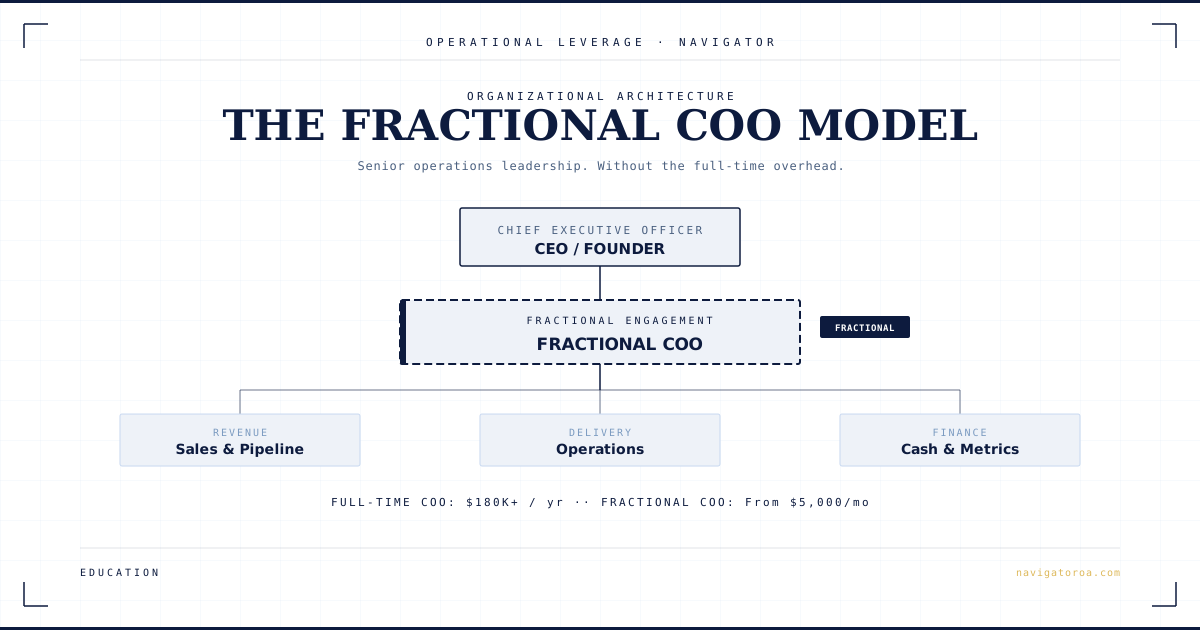
The direct answer: a fractional COO in Canada does not typically bill by the hour, but if you convert a scoped monthly engagement into an hourly equivalent, it lands at roughly $75 to $230 per hour. That number is not a rate card. It is arithmetic, derived from a fixed monthly fee divided by the hours worked. Below is exactly how that math works, and why the monthly figure is the one you should actually be evaluating.
Founders search for an hourly rate because it feels like the most honest way to compare options. If you can reduce everything to dollars per hour, you can line up quotes side by side. The trouble is that hourly billing is the wrong frame for this kind of work, and the moment you understand why, the hourly question mostly answers itself.
The Arithmetic, Shown Plainly
Let us do the conversion, because it is the fastest way to make the number concrete.
A fractional COO build engagement with Navigator runs $5,000 to $10,000 per month, at roughly 10 to 15 hours per week. A month is about 4.33 weeks, so the working hours per month land somewhere between 43 and 65.
Take the two ends of the range and divide:
- At the efficient end, $5,000 per month spread across roughly 65 hours works out to about $77 per hour.
- At a more typical midpoint, say $7,500 per month across 50 to 55 hours, you land around $135 to $150 per hour.
- At the upper end, $10,000 per month across 43 hours works out to roughly $233 per hour.
Round it out and the honest hourly-equivalent band is roughly $75 to $230 per hour. That is the number, derived transparently, with no invented rate card behind it.
"The hourly equivalent is a useful sanity check. It is a terrible way to buy the work. You are not renting hours. You are buying an operating system that keeps running after the hours end."
Why Fractional COOs Do Not Sell Hours
Here is the part that matters more than the arithmetic. The best fractional operators deliberately avoid hourly billing, and it is worth understanding why, because it protects you.
Hourly billing rewards the wrong thing. When a consultant bills by the hour, every hour of slowness is revenue for them and cost for you. The incentive is misaligned from the first invoice. A monthly scoped engagement inverts that: the fee is fixed against an outcome and a window, so the operator's incentive is to work efficiently and finish. Speed becomes a shared goal instead of a threat to the bill.
Hourly billing makes the invoice unpredictable. With an hourly arrangement, you cannot budget with confidence. Every clarifying conversation, every extra revision, every "quick question" is billable, and the total is only known in hindsight. A monthly engagement gives you one predictable number you can plan around.
Hourly billing fragments the work. Operational redesign is not a series of discrete tasks. It is continuous, connected work: documenting a process reveals a decision-rights gap, which reveals a visibility gap, which reveals a delivery inconsistency. Billing that by the hour encourages both sides to carve it into pieces that can be timed, which is exactly the wrong way to build a system that has to hang together.
This is the same logic that leads good operators away from hourly work and toward the outcome-based model we described in How Much Does an Operations Consultant Cost in Canada?. The pricing structure is not a detail. It shapes the entire relationship.
Reading about the problem? Score your own operations.
25 checks, 5 pillars, about 7 minutes. Your gaps appear on screen.
What the Monthly Number Actually Buys
When you commit to a monthly engagement instead of an hourly one, you are buying a few things the hourly model cannot deliver.
You are buying continuity of attention. A fractional COO carrying your business in their head across a full engagement makes better decisions than one who logs in for billable blocks and context-switches away. The value compounds across weeks in a way that hours cannot capture on an invoice.
You are buying a defined outcome. A build engagement is scoped to install specific systems over 10 to 16 weeks. You know what you are getting and roughly when. That is a fundamentally different purchase than a bucket of hours with no defined finish line.
You are buying senior judgment applied to your constraint. The reason to hire a fractional COO rather than a junior operator is that the expensive part is not the hands, it is the diagnosis: knowing which of your ten problems is the actual bottleneck, and in what order to fix them. You cannot buy that by the hour in any meaningful way.
The Operations Audit: 25 questions that reveal where your constraint lives before you commit to any engagement.
FREE · SCORED ON SCREEN IN ABOUT 7 MINUTES
The Full Pricing Picture
To keep the hourly question in context, here is where the monthly figures sit across the range of engagements.
- A build engagement runs $5,000 to $10,000 per month at 10 to 15 hours per week, over 10 to 16 weeks.
- An ongoing retainer, once the build is complete, runs $2,000 to $5,000 per month.
- The 90-Day Reset runs $5,000 to $7,000 per month for a business that needs stabilizing.
- A Strategy Map is a fixed $1,500 for a diagnosis and prioritized plan.
Across all of it, a fractional COO engagement with Navigator falls within $3,000 to $15,000 CAD per month.
Now put that beside the full-time alternative. A full-time COO in Canada costs $150,000 to $300,000 per year, or about $12,500 to $25,000 per month in salary alone, before you add the $20,000 to $50,000 it typically costs to recruit the role. Convert the full-time salary to an hourly equivalent across a standard work month and you will find the fractional hourly-equivalent is competitive or lower, while giving you senior operators instead of a single hire you have to gamble on. The fractional COO cost page lays out that comparison in full.
When Hourly Actually Makes Sense
To be fair, there is a narrow case for hourly work. If you have a single, well-defined, self-contained task, something with a clear start and stop that does not touch the rest of your operations, paying hourly for that task can be reasonable. Fixing one broken automation. Reviewing one contract process. A bounded audit.
But operational transformation, the kind that removes a founder as the bottleneck and installs systems that run without them, is not a bounded task. It is connected, continuous work. Trying to buy it by the hour is like trying to buy a house by the brick. You can count the bricks, but you are not really pricing the thing you need.
The Bottom Line
If you need a number, the hourly equivalent of a fractional COO engagement in Canada is roughly $75 to $230 per hour, derived by dividing a $5,000 to $10,000 monthly fee across 10 to 15 hours a week. But the operators worth hiring will steer you toward the monthly figure on purpose, because it aligns their incentives with your outcome and gives you a number you can actually budget.
Navigator has done this work since 2002, more than 25 years, with over 1,000 leaders. We publish our ranges precisely so you never have to reverse-engineer an hourly rate to figure out what something costs.
If you want a concrete monthly number scoped to your business, the fastest path is a short conversation.
45 minutes. We scope your engagement and give you one transparent monthly number, not a meter.
FREE · SCORED ON SCREEN IN ABOUT 7 MINUTES
OPERATIONAL LEVERAGE, WEEKLY DISPATCH
Get frameworks like this every week.
No padding, no filler, just field-tested operational tactics for Canadian Founders.
Prefer LinkedIn? Subscribe to Operational Leverage on LinkedIn.
Where is your business leaking growth?
25 checks across 5 operational pillars. Your score and your gaps appear on screen in about 7 minutes.