How to Stop Being the Bottleneck in Your Own Business
If your business requires your daily operational involvement to function, you haven't built a company, you've built yourself a very stressful job. Here's the exact framework to change that.

Founder & CEO · Navigator · Sudbury, Ontario
Dawn Larsen has been inside more than 1,000 Founder-led businesses over 25 years. The single most common constraint she finds is not the market, not the product, not the team.
It's the Founder.
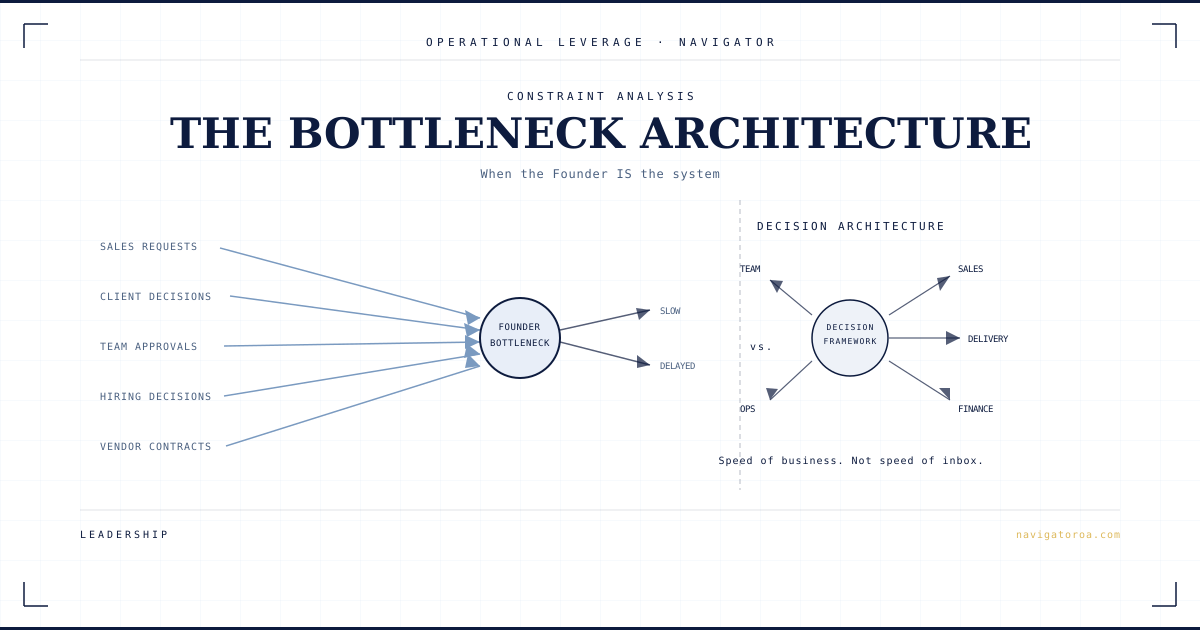
Not because Founders are bad operators. But because the skills that make someone exceptional at starting a business, fast decisions, high standards, hands-on involvement, deep expertise, are the exact same skills that, at scale, create a business that cannot function without them.
"You didn't build a bottleneck on purpose. You built a business that needed you to survive, and now it can't imagine doing without you."
This is the Founder bottleneck, and this pattern of founder dependency is the most expensive operational problem in a growing Canadian business.
How to Know If You're the Bottleneck
These are the diagnostic signals. Be honest with yourself.
- Your Slack is full of "can I get approval for..." messages. Anything that requires your sign-off before it can move is creating a queue. That queue is costing you throughput and your team momentum.
- Projects stall for days while waiting for your review. If your absence creates a traffic jam, you are a single point of failure in your own operations.
- Your team asks you how to handle situations you've handled a hundred times. This is a documentation problem, not a team problem. If you've made the same decision forty times and it's not written down, you've created a dependency.
- You're doing the final quality check on everything. Your standard of quality lives in your head, not in a documented benchmark. That means only you can enforce it.
- You cannot take two weeks off without revenue or delivery being affected. This is the clearest signal. A business that cannot survive its Founder's absence for two weeks is not a business, it's a dependency.
If three or more of these are true, you are the bottleneck. The business has outgrown the informal Founder-driven model that built it.
Why Founders Become Bottlenecks
Understanding the root cause matters because it tells you where to intervene.
The decision reflex. Early-stage Founders make decisions fast because they have to. At scale, this reflex doesn't disappear, it just starts creating a queue of people waiting for your decision instead of making their own.
The quality standard that lives only in your head. You have a standard for how your business operates. You've never written it down because you've always been the one enforcing it. This creates a system where quality can only be as good as your personal involvement.
The approval loop. You started approving things because the consequences of a mistake were high. As the business grew, the approval loop stayed, even for decisions where the consequence of being wrong is minimal.
The communication vacuum. You know the context, history, and reasoning behind every decision. Your team doesn't, because it was never documented. So they ask you, because you're the only one who knows.
The Growth-Stage Operator's Blueprint, delegation framework, decision rights, and accountability systems
FREE · SCORED ON SCREEN IN ABOUT 7 MINUTES
Reading about the problem? Score your own operations.
25 checks, 5 pillars, about 7 minutes. Your gaps appear on screen.
The Three-Part Framework for Removing Yourself
This is the framework Dawn uses in every Navigator engagement where Founder bottleneck is the primary constraint. It has three parts, and they must be built in order.
Part 1: Documentation (Get it out of your head)
Before you can delegate effectively, the knowledge required to execute must exist outside of you. This means:
- Writing the core delivery SOP, how your business actually fulfills its promise to clients, step by step
- Documenting the decision logic you use most frequently, not the decisions themselves, but the parameters you use to make them
- Creating a quality benchmark, what "great" looks like for your most important deliverable, with examples
This is not glamorous work. It is the most important operational work you will do this year. Every hour you spend documenting is worth ten hours of future management time.
Part 2: Delegation (Give authority, not just tasks)
Most Founders delegate tasks but keep the authority. This fails every time. You hand your team member a task, but every decision within that task still requires your sign-off. You've created the illusion of delegation while maintaining all the actual bottlenecking.
Real delegation transfers authority within defined bounds:
- Decision thresholds: "You can approve any expense under $500 without my sign-off."
- Quality authority: "You are responsible for the final quality check on client deliverables. Use the quality benchmark document."
- Client authority: "You own the client relationship for your accounts. Escalate to me only if the client requests it or a project is more than five days behind."
Build a Decision Rights document. For every recurring decision type: who decides, who is consulted, who is informed. Distribute it. Enforce it by not accepting escalations that fall within the defined authority.
OPERATIONAL LEVERAGE, WEEKLY DISPATCH
Get frameworks like this every week.
No padding, no filler, just field-tested operational tactics for Canadian Founders.
Prefer LinkedIn? Subscribe to Operational Leverage on LinkedIn.
Part 3: Visibility (Replace presence with metrics)
The reason Founders stay in the operational weeds is often legitimate: they don't have another way to know what's happening. If you remove yourself from daily involvement without building a visibility system, you're just creating blind spots.
Build two visibility mechanisms:
A weekly async status update. Every team member submits a written update by end-of-day Friday. You read them Monday in 20 minutes. You know what's happening without attending every conversation.
A metrics dashboard. Five to seven numbers that tell you whether the business is operating within acceptable parameters. You check it Monday morning. You only intervene when a number falls outside its defined range.
When you have documentation, authority delegation, and visibility systems in place, you can stop managing by presence. You start managing by exception, only intervening when something falls outside the normal operating range.
What Changes When the Bottleneck Is Removed
In our experience across 1,000+ engagements, Founders who successfully remove themselves as the operational bottleneck report:
- 10–15 hours per week returned, time previously spent on approvals, reviews, and questions their team now handles independently
- Faster execution across the business, projects stop waiting in a queue for the Founder's attention
- A team that grows into their roles, when people have real authority and real accountability, they rise to it
- The ability to work on the business instead of in it, strategy, growth, relationships, the things only the Founder can do
And perhaps most importantly: the ability to take a real vacation without their phone in their hand.
The Operations Audit, 25 questions that identify exactly where your bottleneck lives
FREE · SCORED ON SCREEN IN ABOUT 7 MINUTES
The Fastest Path Forward
If you've read this and recognized your business in it, the fastest path forward is not trying to solve this alone. The Founder bottleneck is notoriously difficult to self-diagnose and self-treat, partly because the person who is the bottleneck is also the person who would need to lead the change.
That's precisely what an embedded Fractional Operations Architect does. It usually starts with an operations audit to map where the bottleneck actually is (it's often not where Founders think), then we build the documentation, design the delegation framework, and implement the visibility systems, before handing it back to you with a team that can execute without you.
The result isn't that you're less involved in your business. It's that your involvement is strategic, not operational. You're the architect, not the contractor.
That's a better business. And a better life.
Where is your business leaking growth?
25 checks across 5 operational pillars. Your score and your gaps appear on screen in about 7 minutes.