10 Signs Your Business Has Outgrown Its Systems
The systems that carried you to $1M were never designed to carry you past it. Here are ten specific, diagnosable signals that your operations have quietly hit their ceiling, and what each one is actually telling you.

Founder & CEO · Navigator · Sudbury, Ontario
Most Founders do not notice the day their systems stopped fitting. There is no alarm. The spreadsheets still open. The team still shows up. Revenue is still growing. What changes is subtler: everything takes a little more effort than it should, and the effort keeps climbing while the results flatten.
The systems that carried you to $1M were built for a smaller, simpler version of your business. They were never designed to carry you past it. The question is not whether they will strain, it is whether you will recognize the strain before it costs you a quarter or a key employee.
Here are ten specific, diagnosable signals that your operations have outgrown their systems. Read them the way you would read a diagnostic panel: not every one will apply, but if three or more do, your constraint is structural, not effort.
1. Everything Still Routes Through You
The clearest signal is also the most personal. If approvals, quality checks, exceptions, and difficult decisions all funnel back to you, your business is running on a system that lives in your head and nowhere else. This is not a character flaw and it is not a sign you are indispensable. It is a removable growth ceiling. The business made you the operating system when it was small, and it never upgraded. That is fixable, and it is exactly the pattern we unpack in How to Know If You're the Bottleneck (And What to Do About It).
2. New Hires Take Too Long to Become Useful
When onboarding a new team member means weeks of you verbally transferring knowledge that lives only in your memory, you do not have an onboarding system, you have a repeated act of translation. A business with mature systems can bring a competent hire to productivity quickly because the knowledge is documented, findable, and followable. If every new person resets your calendar for a month, your institutional knowledge has outgrown its container.
Reading about the problem? Score your own operations.
25 checks, 5 pillars, about 7 minutes. Your gaps appear on screen.
3. Quality Depends on Who Happens to Handle the Work
If a client's experience varies based on which team member gets assigned, you do not have a delivery system. You have a group of capable people each doing their own interpretation of "good." That works until it does not, and the failure mode is a client who quietly leaves because their experience dipped and no one caught it. Consistent quality comes from documented standards and checkpoints, not from hoping the right person is available.
4. Your Margin Shrinks as Revenue Grows
This is the most financially dangerous signal, because it is counterintuitive. You would expect scale to improve margin. When it does the opposite, when you are doing more revenue at a lower margin than a year ago, delivery inefficiency is eating your growth. You are adding clients faster than you are adding the capacity to serve them well, and the gap is being filled by expensive human effort. That is a system problem wearing a financial disguise.
5. You Find Out About Problems From Clients
If a client tells you they are unhappy before your own team does, your monitoring failed. Healthy operations surface problems internally, early, through visibility systems that flag trouble before it reaches the customer. When the customer is your early-warning system, you are always responding late, and late responses cost retention.
The Operations Audit: 25 questions that turn these ten signals into a scored map of your actual constraint.
FREE · SCORED ON SCREEN IN ABOUT 7 MINUTES
6. Your Tools Have Become Held Together by Hope
Fourteen spreadsheets that reference each other. A CRM someone has to manually update from an inbox. A "system" that only works because one person remembers the workaround. When your tooling requires human middleware, people doing the job an integration should do, you have outgrown the improvised stack that got you here. The tools are not the root problem, but they are a loud symptom of one, and closing that gap is what business process automation is for.
7. Nobody Knows Who Actually Decides
Ask two people who has authority over a given decision and you get two different answers, or worse, both say "check with the Founder." When decision rights are undefined, every non-trivial choice defaults upward by gravity, and the business moves at the speed of a single calendar. A business that has outgrown its systems is usually a business that never wrote down who decides what.
8. Growth Feels Threatening Instead of Exciting
Pay attention to your own emotional reaction to opportunity. If the thought of three new clients makes you anxious rather than motivated, that anxiety is data. It means some part of you already knows the current system cannot absorb the load. Founders with systems that fit feel eager about growth. Founders whose systems have topped out feel dread, because they will personally absorb every new unit of chaos.
9. The Same Fires Keep Restarting
Every business fights fires. The signal is not the fire, it is the recurrence. If you keep solving the same problem, the same missed handoff, the same billing error, the same dropped follow-up, you are treating symptoms because there is no system that fixes the root. Mature operations turn a solved problem into a documented process so it stays solved. Outgrown operations solve the same thing over and over, forever.
10. You Cannot Take Two Weeks Off
This is the master signal, the one that contains most of the others. If you cannot step away for two weeks without revenue dipping, quality slipping, or decisions stacking up, the business does not run on systems. It runs on your continuous presence. A company that cannot survive its owner's absence is not yet a company in the durable sense. It is a high-performing job with employees attached, and the difference matters enormously the day you want to sell, scale, or simply rest.
What These Signals Have in Common
Notice the through-line. Every one of these ten signals traces back to the same root: the business is running on the founder's presence and memory rather than on documented, delegatable systems. That is why pushing harder on sales never fixes any of them. More revenue poured into a business with outgrown systems does not relieve the strain, it amplifies it. Each new client meets the same undocumented delivery, the same undefined decisions, the same single point of failure.
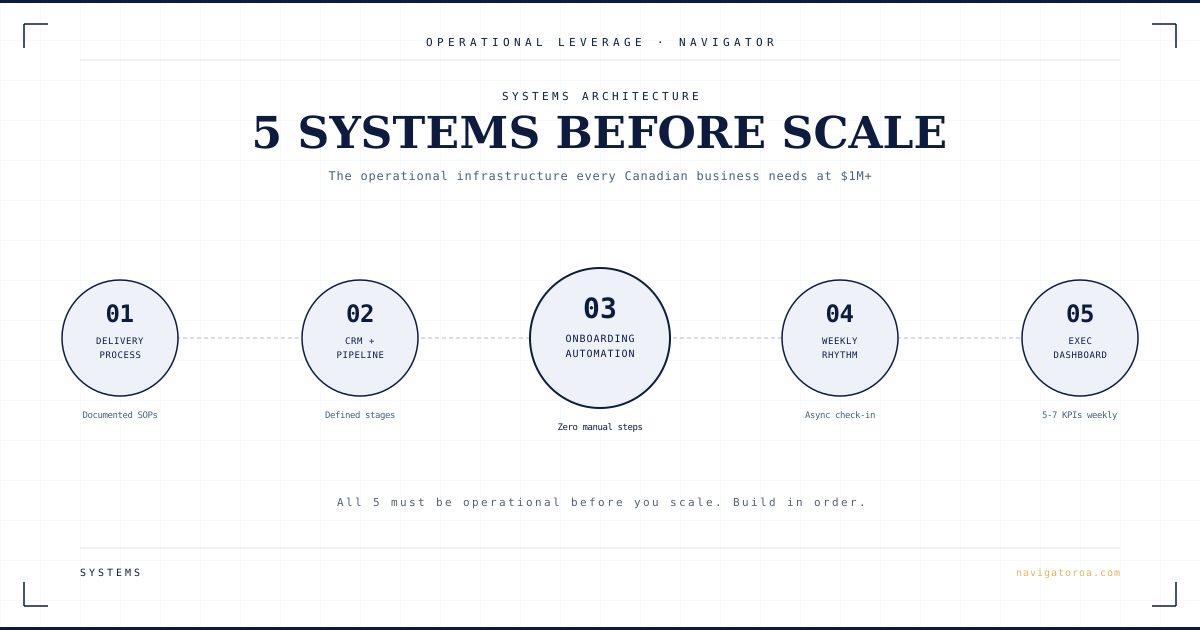
The fix is not effort. It is architecture: the SOP development, decision rights, visibility systems, and delivery standards that let the business run to your standard without your constant involvement. That work has a natural sequence, which we lay out in The 5 Systems Every Canadian Business Needs Before Scaling.
What to Do With This
If you counted three or more signals, resist the instinct to fix them one at a time in whatever order they annoy you most. They are connected. The right first move is a diagnosis that tells you which constraint is actually load-bearing, because fixing a downstream symptom before the upstream cause just moves the bottleneck.
That is the work a fractional COO leads: finding the constraint, sequencing the build, and installing systems that hold after they leave. Navigator has done exactly this since 2002, more than 25 years, across over 1,000 leaders, and we have been named Consulting Company of the Year three times by BestRated.ca.
Your systems got you here. That is not a failure, it is proof they worked. But they were built for a smaller business, and the honest move is to rebuild them deliberately before growth forces the issue at the worst possible time.
45 minutes. We turn your signals into a prioritized build sequence and tell you what to fix first.
FREE · SCORED ON SCREEN IN ABOUT 7 MINUTES
OPERATIONAL LEVERAGE, WEEKLY DISPATCH
Get frameworks like this every week.
No padding, no filler, just field-tested operational tactics for Canadian Founders.
Prefer LinkedIn? Subscribe to Operational Leverage on LinkedIn.
Where is your business leaking growth?
25 checks across 5 operational pillars. Your score and your gaps appear on screen in about 7 minutes.