The 2 Biggest Problems CEOs Face at $1M (And Why More Revenue Won't Fix Either One)
Almost every Canadian CEO who hits the $1M mark faces the same two invisible walls. They're not market problems. They're not product problems. They're structural problems, and pushing harder on revenue makes both of them worse.

Founder & CEO · Navigator · Sudbury, Ontario
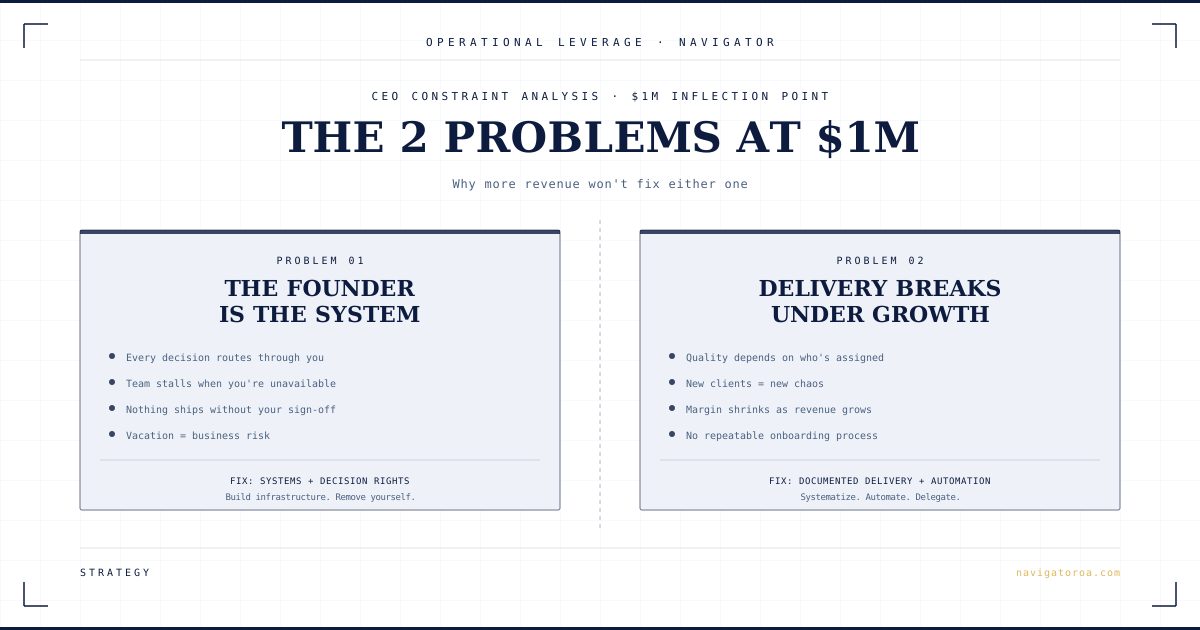
There is a specific conversation Navigator has had with hundreds of Canadian CEOs. The details change, the industry, the revenue number, the team size, but the core of the conversation is always the same.
The CEO is working harder than they ever have. Revenue is real. Clients are real. The team exists. And yet somehow everything feels like it's barely holding together. More growth feels threatening, not exciting. The idea of taking on three more clients makes them anxious, not motivated.
This is not a motivation problem. This is not a market problem. This is not a hiring problem.
These CEOs have hit the two structural walls that appear almost universally at the $1M inflection point. And the reason so many of them stay stuck, sometimes for years, is that they keep trying to solve structural problems with sales tactics and sheer force of will.
"More revenue doesn't fix a structural problem. It accelerates it. Every new client you add to a broken system makes the system more broken."
Here are the two problems. They are specific. They are diagnosable. And they are both fixable, but only if you understand exactly what you're dealing with.
---
Problem One: You Are the System
At some point between your first dollar of revenue and your first million, your business quietly made a decision without asking you. It decided that *you* would be the operating system. Not a process. Not a documented workflow. Not a set of clearly owned roles with defined decision authority.
You.
Every approval. Every quality check. Every exception. Every difficult client conversation. Every hiring decision. Every pricing call. Every communication that matters.
It routed through you, because in the early days, you were the only one who knew what "good" looked like. And it worked, right up until it didn't.
### How to Know This Is Your Problem
The diagnostic is uncomfortable but precise:
Your Slack, email, or phone is a queue of approval requests. If your team's primary form of communication with you is "can I get sign-off on this?", the decision-making infrastructure of your business lives inside your head, and nowhere else.
Things stall when you're unavailable. If you take a day off and come back to three things that have been waiting for you, you are a single point of failure. In engineering, a single point of failure is considered a critical defect. In business operations, this kind of founder dependency is somehow normal. It shouldn't be.
New hires take longer than 60 days to become productive. Not because they're slow. Because the onboarding is you, verbally transferring institutional knowledge that was never documented. You're reteaching the same things every time you hire someone, because the system is still in your head.
You do the final quality check on everything. Your quality standard (what "good" looks like for your offer) exists as a personal judgment call that only you can make. That means your quality is fundamentally capped by your availability.
You cannot take two weeks off without the business being affected. This is the clearest signal. A business that cannot survive its CEO's absence is not a business. It is an elaborate personal services arrangement that happens to have employees.
### Why This Happens
You did not create this problem by being a bad operator. You created it by being a good one, in the wrong stage.
The decisions you made fast in year one (that kept clients happy, that maintained quality, that resolved problems before they escalated) were the right decisions for a $300K business. At $1M, those same instincts have calcified into a system where nothing moves without you.
The speed you valued became a bottleneck. The standards you enforced became a single point of failure. The expertise you carried in your head became the thing preventing anyone else from carrying it.
### What Actually Fixes It
This problem has one solution, and it is not hiring more people or delegating more tasks.
The solution is building *delegation infrastructure*: the systems, documentation, and decision frameworks that allow your team to execute to your standard without your involvement.
Specifically, that means:
Documented processes for every critical workflow. Not vague guidelines. Step-by-step SOPs with decision criteria, named owners, and completion standards. If the answer to "how do we do X?" is "ask Dawn," you don't have a process, you have a dependency.
A Decision Rights document. This is the single most underbuilt system in growing businesses. It is a written document that specifies, for every recurring decision type, who has the authority to decide, at what threshold, and when they must escalate. Without this, every decision defaults to you by gravity.
Quality standards made explicit. Write down what "good" actually looks like for each element of your offer. If you've been maintaining quality through personal review, the first step to removing yourself is making the standard visible enough that someone else can enforce it.
A visibility system that doesn't require your presence. A weekly async status update from every team member. A dashboard of 5–7 key metrics you review Monday morning. This is how you stop managing by being in the room and start managing by exception, intervening only when the numbers fall outside acceptable bounds.
The Operations Audit: 25 questions that reveal exactly where your bottleneck lives and what to build first
FREE · SCORED ON SCREEN IN ABOUT 7 MINUTES
None of this is glamorous. All of it is necessary. The CEOs who build this infrastructure stop being the bottleneck. The ones who don't spend the next three years working harder and harder to produce the same result.
---
Problem Two: Your Delivery Breaks Under Growth
The second problem is quieter but equally expensive. It doesn't announce itself with a crisis. It shows up as a slow erosion of margin, an inconsistency in client experience, and a creeping sense that more growth is going to make things worse, not better.
The problem is that your delivery model was built for the volume you had, not the volume you want. And at $1M, most CEOs are discovering that every new client adds a disproportionate amount of operational friction.
### How to Know This Is Your Problem
Delivery quality varies by who's assigned. If a client's experience depends on which team member handles them, you do not have a delivery system. You have a collection of talented individuals doing their best interpretation of what you want. That is not scalable.
Every new client engagement starts from scratch. If onboarding a new client requires a round of manual emails, a kickoff call to explain things that should have been in a document, a folder structure that someone has to create by hand, you have no repeatable onboarding infrastructure. Each new client is a custom project.
Your margin shrinks as revenue grows. This is the most financially damaging signal. If you're doing $1M in revenue but your margin is lower than it was at $600K, delivery inefficiency is eating your growth. You're adding clients faster than you're adding capacity to serve them well, and the gap is filled by human effort that costs more than it should.
Client complaints are episodic and hard to predict. If you can't predict which clients will have a problem and which won't, your delivery process has no quality checkpoint. Problems are found by clients before they're found by you.
You lose good team members because the work is chaotic. High-performing employees leave chaotic operations. When your delivery model requires constant improvisation and Founder involvement, you attract people who can tolerate chaos and lose the ones who need clarity.
45 minutes. We'll map your delivery constraint and tell you exactly what it would take to fix it.
FREE · SCORED ON SCREEN IN ABOUT 7 MINUTES
### Why This Happens
In the early stages of a business, the Founder is the delivery system. You know how to do the work at your standard, you do it or closely supervise it, and quality is maintained because you are personally involved in every engagement.
This is sustainable at $300K. It is unsustainable at $1M.
At some point, you had to bring in team members to help deliver. And you trained them, but training is not a system. Training is a transfer of tacit knowledge that lives in someone's memory and degrades every time there's staff turnover or ambiguity. What you actually needed to build was a delivery architecture: the documented processes, quality standards, onboarding flows, and accountability structures that allow any competent team member to deliver to your standard without your personal involvement.
Most CEOs skip this step because it's slower than just training someone and getting them started. They pay for that shortcut for years.
"The business you built to get to $1M was built on your personal delivery capacity. The business that gets you to $3M runs on documented, automated, delegatable systems."
### What Actually Fixes It
Fixing broken delivery requires building in a specific sequence:
Step 1: Document the delivery process end to end.
From signed contract to delivered outcome. Every step. Every decision point. Every handoff. Every communication template. This document is the foundation of everything else. You cannot systematize what you haven't defined. See the 5 Systems Every Canadian Business Needs Before Scaling for the exact sequence.
Step 2: Build an automated onboarding sequence.
Every new client should trigger a sequence that requires zero manual steps from your team: a welcome email with next steps, an intake questionnaire, a folder structure creation, a kickoff scheduling link, and a timeline document. If any of these happen manually today, they are automation opportunities that will free 3–5 hours per client onboarding.
Step 3: Define quality checkpoints.
At which stages of delivery do you need a human quality check? Define what "pass" looks like at each stage, who owns that check, and what happens when something doesn't pass. This is how you get consistent client outcomes without being the quality filter.
Step 4: Build a client health monitoring system.
A simple dashboard that tracks, for every active client, the key health metrics: last contact date, deliverable status, satisfaction signal, upcoming milestone. If you find out a client is unhappy from the client, your monitoring system failed. You should know before they do.
---
Reading about the problem? Score your own operations.
25 checks, 5 pillars, about 7 minutes. Your gaps appear on screen.
Why These Two Problems Compound Each Other
Here is the part that makes the $1M wall so punishing: these two problems are not independent. They feed each other.
When you are the system (Problem One), your delivery depends on your involvement (Problem Two). When your delivery is undocumented (Problem Two), the only person who can enforce quality is you (Problem One). The two constraints lock together and the only way to grow is to work harder, which makes both problems worse.
The CEOs who break through the $1M wall cleanly (who go from $1M to $3M without destroying their health, their margins, or their team) do one thing differently from the ones who stay stuck: they fix the infrastructure before they push harder on growth.
They build the delegation systems and the delivery architecture simultaneously. They treat operational infrastructure as the work, not as the administrative burden that sits beside the real work.
Where to Start
If both problems resonate, start with the one that's costing you the most right now.
If your primary constraint is *time* (you are personally overwhelmed, decisions are backed up, the team can't operate without you): start with Problem One. Build the delegation infrastructure. Document the decision rights. Get yourself out of the approval queue.
If your primary constraint is *quality and margin* (clients are having inconsistent experiences, delivery is chaotic, profit is eroding): start with Problem Two. Map your delivery process. Build the onboarding automation. Define the quality checkpoints.
Both are fixable. Both require the same thing: an honest operations audit of where the constraint actually lives, followed by deliberate architectural work to eliminate it.
That audit is exactly what Navigator's Operations Diagnostic delivers. Two weeks. A complete map of your operational constraints. A prioritized build sequence. And an honest assessment of whether we can help.
The Pre-Scale Foundations Blueprint: the operational infrastructure every $1M CEO needs to build before their next growth push
FREE · SCORED ON SCREEN IN ABOUT 7 MINUTES
The Founders who fix these two problems before they push harder on growth scale to $3M, $5M, and beyond. The ones who don't spend three years doing more work for the same result.
OPERATIONAL LEVERAGE, WEEKLY DISPATCH
Get frameworks like this every week.
No padding, no filler, just field-tested operational tactics for Canadian Founders.
Prefer LinkedIn? Subscribe to Operational Leverage on LinkedIn.
Where is your business leaking growth?
25 checks across 5 operational pillars. Your score and your gaps appear on screen in about 7 minutes.