What Does a COO Actually Do All Day?
The title is vague on purpose, which is why it confuses so many Founders. A COO's real job is not a list of tasks. It is to own how the business runs so the CEO can own where it goes. Here is what that looks like on an ordinary Tuesday.

Founder & CEO · Navigator · Sudbury, Ontario
Ask ten people what a COO does and you will get ten answers, most of them vague. That vagueness is not an accident. The chief operating officer role is deliberately broad, because its actual job is to own everything between the CEO's vision and the customer's experience. But "everything in between" is not a satisfying answer if you are a Founder trying to decide whether you need one, so let us make it concrete: here is what a COO actually does, hour by hour and function by function.
The cleanest one-line definition is this. The CEO owns where the business is going. The COO owns how it gets there. The CEO sets the destination and secures the resources. The COO builds and runs the machine that reaches it. When that division is working, the CEO stops living inside the operation and starts steering it.
"A CEO who is also acting as the COO is not two executives for the price of one. They are one executive doing neither job well, because the two roles pull in opposite directions: one lives in the future, one lives in the present."
The Core of the Job: Owning How the Business Runs
Strip away the specifics and a COO's mandate is singular: make the business run predictably, consistently, and without requiring the CEO's constant involvement. Everything a COO does in a given day rolls up to that one purpose.
That mandate breaks into a handful of recurring responsibilities that fill the actual hours.
Turning strategy into execution. The CEO says "we are going to double our enterprise client base this year." The COO's job is to translate that sentence into an operational reality: the capacity plan, the delivery adjustments, the hiring sequence, the process changes that make doubling possible without the wheels coming off. Strategy without execution is a wish. The COO is where the wish becomes a plan with owners and dates.
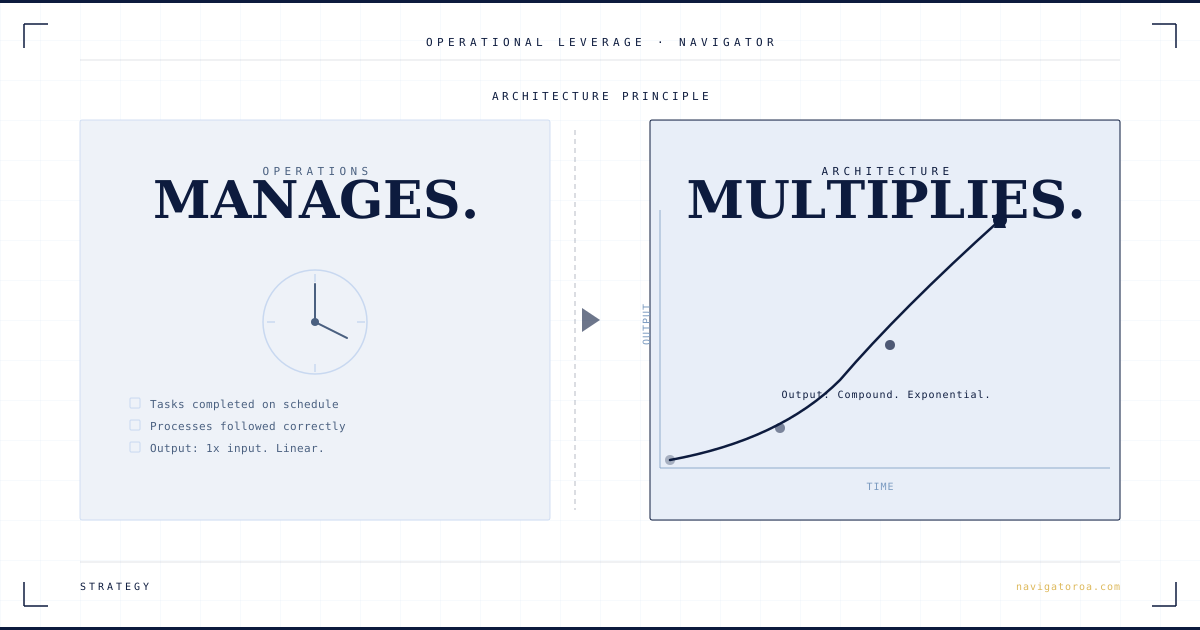
Building and maintaining the systems. A COO thinks in systems, not tasks. When a problem appears, the operator instinct is not to solve this instance, it is to build the process that prevents the next hundred instances. This is the difference we drew out in Why a Company Needs an Operations Manager and an Operations Architect: managing keeps today's work moving, but a COO's higher job is architecting the systems that multiply the team's output.
Managing by exception. A mature COO does not review every piece of work. They build visibility, dashboards, status cadences, health metrics, so that the normal case runs on its own and only the exceptions reach their desk. A COO's day is spent reading the signals and intervening where the numbers fall outside acceptable bounds, not doing the work the team is there to do.
What a Tuesday Actually Looks Like
To make it tangible, picture an ordinary mid-week day for a COO in an owner-operated business.
Early morning is review, not reaction. Before anyone needs anything, the COO reads the dashboard: revenue run rate, pipeline movement, cash position, client health, project status, team utilization. Five to seven numbers that tell them where the business actually is. Ninety percent of these numbers will be fine. The job is finding the ten percent that are not, before they become a crisis someone escalates in a panic later.
Mid-morning is the exceptions. A client health score dipped. A delivery milestone is at risk. A team member flagged a blocker in their async update. The COO works these, not by doing the frontline work, but by removing the obstacle, reassigning the resource, or making the decision the team lacks authority to make. Each one gets handled and, where it is a recurring pattern, gets turned into a process so it stops recurring.
Midday often includes a one-on-one or two. Not status meetings, those happen asynchronously, but calibration: keeping a team lead's judgment aligned with the standard, coaching through a hard call, unblocking a decision. A COO spends real time developing the layer of people who run the operation day to day, because a COO's leverage is other people executing well, not the COO executing more.
Afternoon is build time. This is the work that never has a deadline and therefore never gets done unless someone protects the block: documenting the process that has been improvised for months, redesigning the onboarding flow that keeps generating friction, installing the automation that eliminates a recurring manual task. This is the highest-value hour of the COO's day and the first one a weak operator sacrifices to firefighting.
Late day is closing the loops and looking ahead. What did today reveal about next week. What decision does the CEO need to make and what does the COO need to prepare so that decision is easy. A good COO ends the day having moved the machine forward, not just having survived it.
The Operations Audit: 25 questions that show whether your business needs a COO's attention and where.
FREE · SCORED ON SCREEN IN ABOUT 7 MINUTES
Reading about the problem? Score your own operations.
25 checks, 5 pillars, about 7 minutes. Your gaps appear on screen.
What a COO Is Not
It helps to draw the boundaries, because the role gets conflated with adjacent ones.
A COO is not an office manager or a senior administrator. The work is architectural and strategic, not clerical. A COO is not a project manager, though they build the systems project managers run within. And a COO is not a second CEO. They are the CEO's operational counterpart, deliberately focused on the present and the how, precisely so the CEO can focus on the future and the where.
The confusion matters because Founders often try to solve a COO-shaped problem with a lower-leverage hire, and then wonder why the bottleneck did not move. The bottleneck did not move because the missing function was senior operational ownership, and they hired hands instead of judgment.
Do You Need a Full-Time One?
Here is the practical question most Founders are actually asking. The COO function is essential once a business passes a certain complexity. Whether you need it as a full-time hire is a separate question.
A full-time COO in Canada costs $150,000 to $300,000 per year, roughly $12,500 to $25,000 per month in salary, plus $20,000 to $50,000 to recruit the role and months of ramp before they are productive. For a business under roughly $5M, that is often more executive than the operation can justify or afford.
The alternative is a fractional COO: the same senior operational ownership, engaged part-time and scoped to what the business actually needs. Navigator's fractional engagements run $3,000 to $15,000 CAD per month, with a build engagement at $5,000 to $10,000 per month over 10 to 16 weeks and an ongoing retainer at $2,000 to $5,000 per month once the systems are in place. You get the function without the full-time cost, and you can find the full comparison on the fractional COO cost page.
The Real Answer
So what does a COO actually do all day? They own how the business runs. They translate strategy into execution, build and maintain the systems, manage by exception, develop the people, and protect the build time that makes the whole operation better over time. On any given Tuesday, the work is unglamorous and continuous, and its entire point is to make the business run so well that the CEO can stop running it.
Navigator has provided exactly this kind of operational leadership since 2002, more than 25 years, across over 1,000 leaders. If you are doing the COO job yourself on top of the CEO job, that is not efficiency. It is the constraint.
45 minutes. We map the operational work you are personally absorbing and what a COO would take off your plate.
FREE · SCORED ON SCREEN IN ABOUT 7 MINUTES
OPERATIONAL LEVERAGE, WEEKLY DISPATCH
Get frameworks like this every week.
No padding, no filler, just field-tested operational tactics for Canadian Founders.
Prefer LinkedIn? Subscribe to Operational Leverage on LinkedIn.
Where is your business leaking growth?
25 checks across 5 operational pillars. Your score and your gaps appear on screen in about 7 minutes.