Why Delegation Fails in Growing Businesses (And the 4-Layer Infrastructure That Makes It Work)
Most CEOs have tried to delegate and had it fail. Not because their team isn't capable, but because delegation without infrastructure is just wishful thinking. Here's the exact architecture that makes delegation permanent.

Founder & CEO · Navigator · Sudbury, Ontario
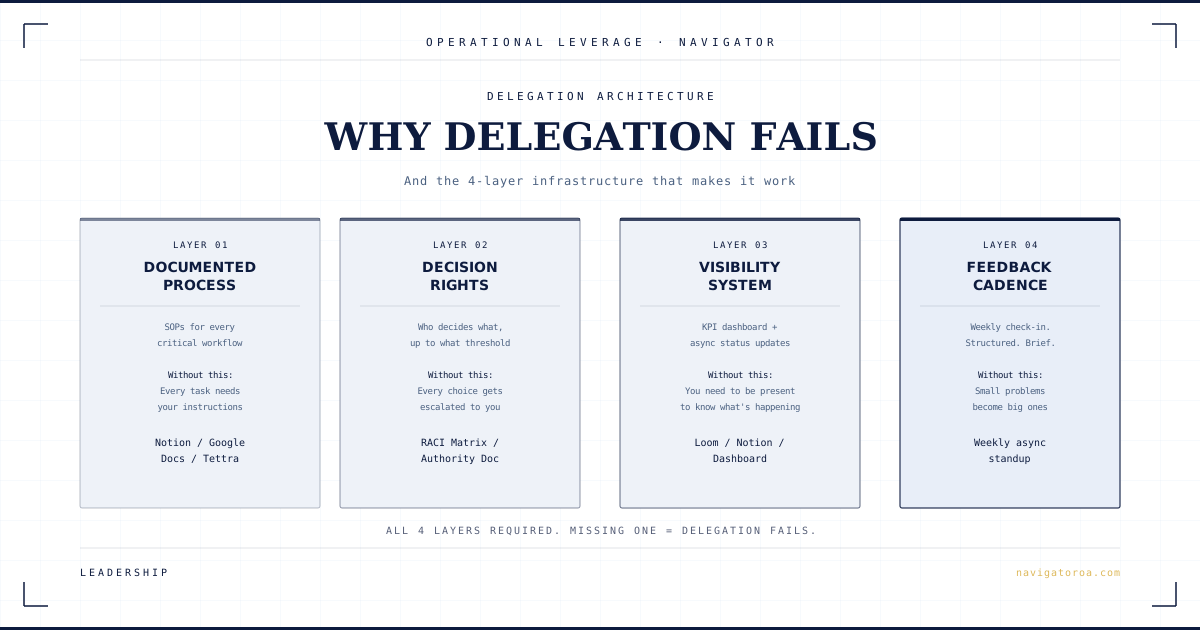
There is a version of delegation that almost every growing CEO has tried and had fail. They hand something off to a team member. The team member does it wrong, or does it inconsistently, or comes back two weeks later with a problem that the CEO then has to solve personally. The CEO concludes that the team member isn't ready, or that delegation doesn't work for this particular type of task, or that it's just faster to do it themselves.
This conclusion is wrong.
The problem was not the team member. The problem was that the CEO tried to delegate without building the infrastructure that makes delegation possible.
Delegation is not an act. It is a system. And like any system, it either works because it was designed to work, or it fails because the underlying structure was missing.
"You can't delegate a task. You can only delegate a task that is supported by documented processes, clear decision authority, a visibility mechanism, and a feedback loop. Everything else is just hoping."
This post is about what that infrastructure actually looks like, why each layer is necessary, and how to build it in the right sequence.
---
Why Delegation Fails: The Real Reasons
Before building the solution, it is worth being precise about the failure mode. Delegation fails for four specific reasons, and they each map directly to a missing infrastructure layer.
Reason 1: The task is not documented.
You know how to do the task. You've done it fifty times. But you've never written down how to do it in a way that removes the need for your judgment at every step. When you hand it off, you give a verbal explanation, which is imprecise, incomplete, and disappears the moment the team member encounters a situation you didn't mention.
Reason 2: The authority is not transferred.
You delegated the task, but you kept the decision-making power. So when the team member hits a fork in the road (a client exception, a pricing question, a timeline conflict), they come back to you. Every time. Because they don't know the boundaries of their own authority, so they default to zero authority and escalate everything.
Reason 3: You have no visibility without being involved.
You delegated the task, but the only way you know how it's going is to ask the person doing it, which creates a dynamic where delegation becomes supervision. You've moved the work but not the cognitive load. You still need to check in constantly because there's no system that shows you whether things are on track without requiring your presence.
Reason 4: There is no feedback loop.
Small errors compound in silence. The team member does the task slightly wrong. Without a structured feedback mechanism, neither of you knows until there's a client complaint or a missed deadline. By then, the damage is done and the CEO decides delegation is too risky.
Each of these is a design failure, not a people failure. And each one has a specific structural fix.
---
The 4-Layer Delegation Infrastructure
### Layer 1: Documented Process
This is the foundation. Nothing else works without it.
A documented process is not a vague description of what to do. It is a step-by-step sequence with named owners, decision criteria at each fork, completion standards, and the information the person needs to execute each step without asking you. This is the heart of real SOP development.
The test of a good process document is simple: can a competent new hire follow it without asking you a single question? If the answer is no, it is not yet a process document, it is an incomplete draft.
What to document first:
Start with your three highest-frequency tasks: the things you or your team does most often. Not the most complex, the most frequent. Frequency is where the ROI on documentation is highest. If something happens 20 times a month and you save 30 minutes of your involvement per occurrence, that's 10 hours per month back to the business.
Where to store it:
Notion, Google Docs, Tettra: the tool matters less than the accessibility. Every process document should be findable in under 30 seconds by anyone on your team. A process document that exists but can't be found is the same as one that doesn't exist.
The one habit that keeps processes current:
Assign every process document an owner and a quarterly review date. Processes drift. What was accurate six months ago may be outdated today. The owner's job is to update the document when reality diverges from what's written.
See the How to Stop Being the Bottleneck post for the specific framework Dawn uses to identify which processes to document first.
The Operations Audit: 25 questions that pinpoint your documentation gaps and what to systematize first
FREE · SCORED ON SCREEN IN ABOUT 7 MINUTES
### Layer 2: Decision Rights
This is the most underbuilt system in growing businesses, and the absence of it is responsible for more CEO bottlenecks than any other single factor.
A Decision Rights document is a written record of who has the authority to make which decisions, up to what threshold, and under what conditions. It is the difference between a team that can operate and a team that escalates.
The core structure:
For every recurring decision type in your business, specify: - Who decides: the person with primary authority - Who is consulted: people whose input should be gathered before the decision - Who is informed: people who need to know after the decision is made - What is the authority threshold: the boundary at which the decision escalates up
This is sometimes called a RACI matrix (Responsible, Accountable, Consulted, Informed), and when it is implemented correctly, it removes the CEO from the approval loop for every decision that falls within defined parameters.
An example:
*Client discount requests:* Team member decides (up to 10%). Sales lead decides (10–20%). CEO decides (above 20% or for strategic accounts). Finance informed of all decisions above 10%.
Before this document exists, every discount request of any size routes to the CEO. After it exists, the CEO only sees the exceptional cases. That is not a small shift. In a business with 20+ active client relationships, this can reclaim 3–5 hours per week of CEO time that was being spent on decisions that shouldn't require CEO involvement.
What makes it work:
The document must be explicit about the threshold. "Use your judgment" is not a decision right, it is an abdication of the system. The threshold must be specific enough that the team member knows with certainty whether a given situation requires escalation.
### Layer 3: Visibility System
The reason many CEOs cannot delegate is not that they don't trust their team. It is that delegation feels like flying blind. When you are doing the work yourself, you have perfect real-time visibility into its status and quality. When you hand it off, you lose that visibility, and the instinct is to compensate by checking in constantly, which defeats the purpose of delegation.
The solution is a visibility system: a set of tools and cadences that give you accurate, timely information about how delegated work is progressing, without requiring your active involvement to gather that information.
The two components:
*Async status updates.* Every team member submits a brief weekly status update, typically a short Loom video or a structured form covering: what was completed this week, what is planned for next week, and what, if anything, is blocked. This takes 5 minutes to submit and 3 minutes to review. It replaces the need for you to ask "how's it going?" and eliminates the dynamic where small problems stay hidden until they become large ones.
*An executive dashboard.* A set of 5–7 key metrics that are updated automatically (or updated by your team on a set cadence) and reviewed by you every Monday before you open your email. For most businesses at the $1M stage, these metrics include: revenue run rate, pipeline value, cash position, client health score, active project status, and team utilization. These numbers tell you whether anything requires your intervention before anyone has to ask you.
The shift this creates is fundamental. Instead of managing by presence (being in every room, on every thread, in every decision), you manage by exception. You review the numbers. When a number falls outside acceptable bounds, you intervene. When the numbers look right, you don't need to be involved.
This is how CEOs of $10M+ businesses operate. It is not a luxury of scale. It is a prerequisite for getting there.
45 minutes to map your delegation constraints and identify which of the 4 layers is your highest-leverage build
FREE · SCORED ON SCREEN IN ABOUT 7 MINUTES
### Layer 4: Feedback Cadence
The final layer is the one most often skipped, and the one that determines whether delegation compounds or erodes over time.
A feedback cadence is a structured, regular mechanism for reviewing the quality of delegated work and course-correcting before small errors become big problems. Without it, delegation drifts. The team member develops their own interpretation of the standard. The gap between what you want and what you're getting widens slowly and invisibly until there's a client complaint or a visible failure, at which point the CEO concludes that delegation doesn't work.
What a functional feedback cadence looks like:
A weekly 1:1 with each direct report, structured as: 3 minutes on what's going well, 3 minutes on what needs adjustment, 2 minutes on what they need from you. Not a status update meeting; status comes through the async system. This is specifically for calibration: keeping the work quality aligned with the standard.
The critical discipline:
Feedback must be specific and prompt. "Good job" and "that needs to improve" are not feedback, they are evaluations without information. Useful feedback identifies the specific behaviour, explains the gap between what happened and the standard, and describes what to do differently. And it must happen close to the event; feedback given three weeks after the fact is too late to be useful.
Why this layer compounds:
When the feedback cadence is working, delegation improves over time. The team member gets better at executing to the standard. The CEO's review time decreases. The scope of what can be safely delegated expands. Each month, the CEO is doing less operational work and more strategic work.
When the feedback cadence is absent, the opposite happens. Delegation erodes. The CEO starts pulling work back because the quality isn't there. The team loses confidence. The delegation experiment quietly fails.
---
Reading about the problem? Score your own operations.
25 checks, 5 pillars, about 7 minutes. Your gaps appear on screen.
Building the 4 Layers in the Right Sequence
The sequence matters. If you build Layer 2 without Layer 1, your decision rights document will be full of gaps because the underlying processes haven't been defined. If you build Layer 3 without Layer 2, your visibility system will show you problems that your team has no authority to solve.
The correct build sequence is:
First: Document your three most critical processes. (2 weeks, 3–5 hours of focused work)
Second: Write your Decision Rights document. Start with the 10 most common decision types in your business and define the threshold for each. (1 week, 2–3 hours)
Third: Set up your visibility system. Implement the async weekly status update and build your executive dashboard. (1 week, 4–6 hours of setup, then 30 minutes per week to maintain)
Fourth: Establish your feedback cadence. Schedule the weekly 1:1s and commit to the structure for 90 days. (ongoing, 30–60 minutes per team member per week)
The entire infrastructure can be built in 4–6 weeks if you treat it as the work, not as the thing beside the work. Most CEOs take 6 months because they build it around their existing schedule instead of prioritizing it over their existing schedule.
---
The ROI of Getting This Right
Here is what the delegation infrastructure actually produces when it is working:
For the CEO: 8–15 hours per week reclaimed from operational involvement. Those hours redirect to strategy, business development, and the high-leverage decisions only the CEO can make.
For the team: Clarity. The most common reason high-performing employees leave is ambiguity: they don't know what's expected, what authority they have, or how they're being evaluated. The delegation infrastructure eliminates all three sources of ambiguity.
For the business: Scalability. A business where the CEO is the operating system cannot scale past a certain point without the CEO working an unsustainable number of hours. A business with delegation infrastructure can grow revenue without growing the CEO's workload proportionally.
For the clients: Consistency. When delivery is systematized and quality is enforced through documented standards rather than CEO presence, client experience becomes more consistent. Clients notice. It shows up in retention and referrals.
The Founders who build this infrastructure in year three or four are the ones running $5M+ businesses by year six. The ones who don't are still doing the same operational work in year six that they were doing in year two, wondering why more revenue isn't solving the problem.
It won't. The infrastructure has to come first.
OPERATIONAL LEVERAGE, WEEKLY DISPATCH
Get frameworks like this every week.
No padding, no filler, just field-tested operational tactics for Canadian Founders.
Prefer LinkedIn? Subscribe to Operational Leverage on LinkedIn.
For Canadian businesses at the $1M–$5M stage, building this infrastructure is the single highest-ROI operational investment available. It is also the thing most CEOs delay the longest, because it requires pausing the machine to fix the machine.
Navigator exists for exactly this situation. Working with a business operations consultant is one way to build it faster, and the FAQ covers the most common questions about how a fractional operations engagement works, what it costs, and whether it makes sense for your business at your current stage.
Where is your business leaking growth?
25 checks across 5 operational pillars. Your score and your gaps appear on screen in about 7 minutes.